

Get job ready climate skills in just 2–3 weeks
Two practical short courses. Real tools. Real experience. Real confidence.
Registration Closes: January 21, 2026 | Courses Start: January 27, 2026
Choose your course:
Section Styles partners border-top border-bottom

Trusted by leading teams at:
Advance in your role or transition into climate with skills you can prove.
Our courses combine hands on practice, real frameworks, and portfolio ready experience you can use immediately.

Carbon Accounting
Learn how real companies measure their carbon emissions.
* Get instant access to self paced course materials after registration.
-
Course Description: Learn to calculate and categorize emissions across Scopes 1, 2, and 3, and turn data into actionable reduction strategies.
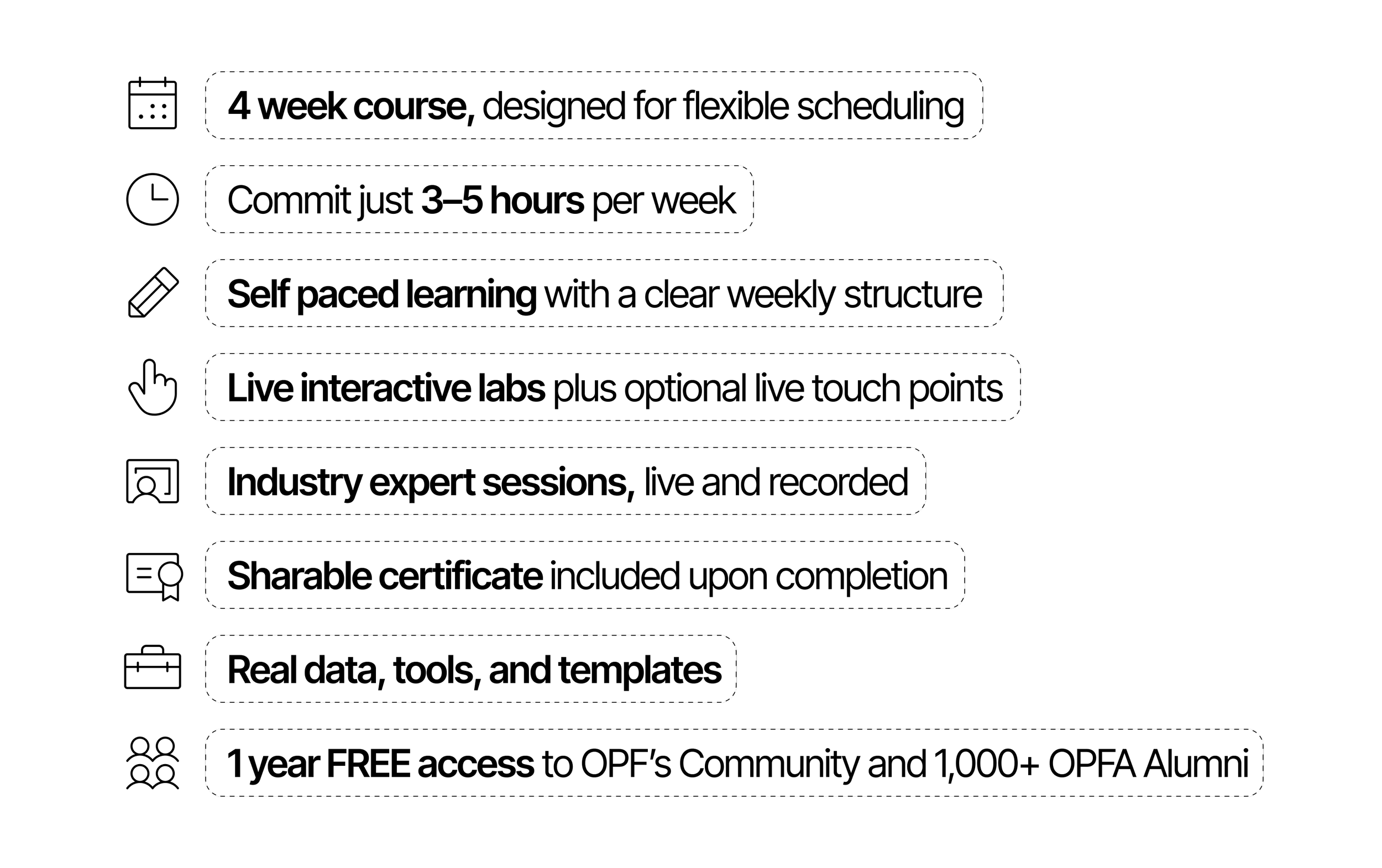
Course Duration: 4 Weeks
Time Commitment: 3–5 Hours/Week
Format: Self-paced with optional live sessions
Live Labs & Touchpoints: Start January 27, 2026
Certificate: Upon completion
Resources: Real data, tools, and templates
Free Access to OPF Learning Community : 1-year
-
Understand mandatory climate disclosure requirements across jurisdictions (California, EU, UK, and emerging global standards)
Navigate the alphabet soup of frameworks and standards (IFRS, TCFD, GRI, SASB, CDP) and understand how they work together
Identify which disclosure requirements apply to your organization based on size, industry, and geography
Report material sustainability metrics with credibility and avoid greenwashing risks
Align sustainability reporting with financial reporting and investor expectations
Respond to increasing stakeholder demands for transparency from investors, customers, employees, and regulators
Turn compliance obligations into opportunities for brand differentiation and market leadership
-
After you complete the course, you’ll be able to:
Enumerate and categorize emissions sources across Scope 1, 2, and 3 using the GHG Protocol framework
Apply the five key principles of GHG accounting (relevance, completeness, consistency, transparency, accuracy) to ensure credible reporting
Set appropriate inventory boundaries (temporal, organizational, and operational) for different business contexts
Calculate GHG emissions using activity-based data and emission factors across all three scopes
Identify the most material emissions categories for different industries using sector-specific guidance
Evaluate data collection methodologies and recommend appropriate approaches based on data availability
Understand both location-based and market-based methods for Scope 2 emissions reporting
Navigate the complete GHG calculation process from boundary setting through reporting and action planning
Discuss the limitations of GHG accounting and recognize when to expand beyond carbon metrics
Recommend reduction strategies tailored to specific emissions sources and industry contexts

Sustainability Reporting & Disclosures
Learn how companies report climate impact (and what they do next).
* Get instant access to self paced course materials after registration.
-
Course Description: Master the frameworks, standards, and regulations driving global sustainability reporting, and learn how transparency creates business value while managing compliance risk.
Course Duration: 4 Weeks
Time Commitment: 3–5 Hours/Week
Format: Self-paced with optional live sessions
Live Labs & Touchpoints: Start January 27, 2026
Certificate: Upon completion
Resources: Real data, tools, and templates
Free Access to OPF Learning Community : 1-year
-
Understand mandatory climate disclosure requirements across jurisdictions (California, EU, UK, and emerging global standards)
Navigate the alphabet soup of frameworks and standards (IFRS, TCFD, GRI, SASB, CDP) and understand how they work together
Identify which disclosure requirements apply to your organization based on size, industry, and geography
Report material sustainability metrics with credibility and avoid greenwashing risks
Align sustainability reporting with financial reporting and investor expectations
Respond to increasing stakeholder demands for transparency from investors, customers, employees, and regulators
Turn compliance obligations into opportunities for brand differentiation and market leadership
-
By completing this module, your team will be able to:
Explain the three primary drivers of sustainability reporting: risk management & compliance, business value creation, and stakeholder expectations
Distinguish between frameworks (TCFD, SDGs), standards (IFRS S1 & S2, GRI, SASB), and regulations (CSRD, SB-253, SECR)
Identify which disclosure requirements apply to your organization based on geography, revenue thresholds, and industry
Understand the four-step process for corporate sustainability reporting: comply with mandates, identify material issues, follow standards, and report progress
Navigate the IFRS S1 & S2 standards and understand their role in creating global baseline disclosures
Use materiality assessment tools to identify relevant sustainability topics and metrics for your industry
Differentiate between ESG reporting, sustainability reporting, and climate reporting based on scope and audience
Report Scope 1, 2, and 3 emissions alongside other environmental metrics (energy, water, waste, ecological impact)
Recognize the limitations of reporting without execution and the importance of credible transition plans
Leverage sustainability transparency as a strategic differentiator for investors, customers, and talent
Registration Closes: January 21, 2026 | Courses Start: January 27, 2026

Section Styles border-top
Who You Will Learn With
Core Curriculum Instructors & Industry Expert Speakers
OPF Academy training is delivered by experienced facilitators who advise leading organizations on strategic sustainability actions every day.

-
![]()
Neil Yeoh
Founder of OnePointFive
-
![]()
Matthias Muehlbauer
Founding Partner of OnePointFive
-
![]()
Julia Akker
Associate Director at OnePointFive
-
![]()
Sarah Paiji Yoo
Blueland Co-Founder and CEO
-
![]()
Oliver "Ollie" Haas
Magpie Aviation
-
![]()
Alexandra Carlson
New Balance
-
![]()
Daniel Hill
Innovation Director at Environmental Defense Fund
-
![]()
Ashlyn Anderson
Cervest
-
![]()
Alexander Pfeiffer
Terralytiq
-
![]()
Shana Gallagher
Our 2050 World
-
![]()
Natalie Lavery
Climate People
-
![]()
Diane Osgood
Carbon Almanac
-
![]()
Miriam Roure
Founder and CEO at Kara













Preview Our Courses
Explore OPF Academy’s actual course modules and see how job ready climate training works.
Section Styles border-top
Section Styles full-width border-top
What to expect:

Section Styles border-top
Who Is OPF Academy For?
We’re on the lookout for professionals and leaders prepared to guide their organizations towards a brighter future.
For Climate Switchers
Launch your climate career with skills, confidence, and proof of work.
Build in demand technical skills fast
Show a real portfolio project on your résumé
Interview with clarity and confidence
Practice with the same tools analysts use on the job


For In-Role Upskillers
Do your sustainability work with confidence, clarity, and real capability.
Get a solid grasp of Scope 3
Improve the accuracy and consistency of your reporting
Communicate insights clearly to leaders and stakeholders
Apply templates and tools immediately in your role


Section Styles border-top
Which course is right for me?

-
Sustainability Reporting & Disclosures: Learn to calculate and categorize emissions across Scopes 1, 2, and 3, and turn data into actionable reduction strategies.
Course Duration: 4 Weeks
Time Commitment: 3–5 Hours/Week
Format: Self-paced with optional live sessions
Live Labs & Touchpoints: Start January 27, 2026
Certificate: Upon completion
Resources: Real data, tools, and templates
Free Access to OPF Learning Community : 1-year
-
Sustainability Reporting & Disclosures: Learn to calculate and categorize emissions across Scopes 1, 2, and 3, and turn data into actionable reduction strategies.Course Duration: 4 Weeks
Time Commitment: 3–5 Hours/Week
Format: Self-paced with optional live sessions
Live Labs & Touchpoints: Start January 27, 2026
Certificate: Upon completion
Resources: Real data, tools, and templates
Free Access to OPF Learning Community : 1-year
-
Start with Carbon Accounting (most do): Master the frameworks, standards, and regulations driving global sustainability reporting, and learn how transparency creates business value while managing compliance risk.
Course Duration: 4 Weeks
Time Commitment: 3–5 Hours/Week
Format: Self-paced with optional live sessions
Live Labs & Touchpoints: Start January 27, 2026
Certificate: Upon completion
Resources: Real data, tools, and templates
Free Access to OPF Learning Community : 1-year
-
Sustainability Reporting & Disclosures: Learn to calculate and categorize emissions across Scopes 1, 2, and 3, and turn data into actionable reduction strategies.
Course Duration: 4 Weeks
Time Commitment: 3–5 Hours/Week
Format: Self-paced with optional live sessions
Live Labs & Touchpoints: Start January 27, 2026
Certificate: Upon completion
Resources: Real data, tools, and templates
Free Access to OPF Learning Community : 1-year
Section Styles border-top

$395 $315
Special launch pricing ends January 8, 2026
Registration closes January 21, 2026 | Flexible payment plans available
Bundle & Save: Get both courses for $876 $699 (save $177)
Carbon Accounting
Sustainability Reporting & Disclosures
Course Bundle
Questions? Contact OPFA