
The Renewable Advantage: Key Takeaways from Our Series on Energy Procurement & Efficiency
We recently completed our 5-part webinar series, Embedding Climate Action into Business Value, in partnership with the Environmental Defense Fund (EDF).
The series concluded with two energy-focused sessions led by Matthias Muehlbauer (Co-Founder & COO, OnePointFive): "The Renewable Advantage” and “Efficiency for Cost & Carbon Savings”, bringing together sustainability professionals looking to reduce cost, manage volatility, and accelerate decarbonization.
Reflecting on the discussions, Matthias Muehlbauer noted:
“Renewables have seen huge reductions in cost and make a strong enough economic argument that firms are still looking for solutions, especially in times when tariffs and economic uncertainty has forced companies to be proactive to protect their margins. We know sustainability professionals are looking to optimize their renewable energy strategy, find quick efficiencies, and avoid price volatility. These are valuable contributions to take to their CFO.”
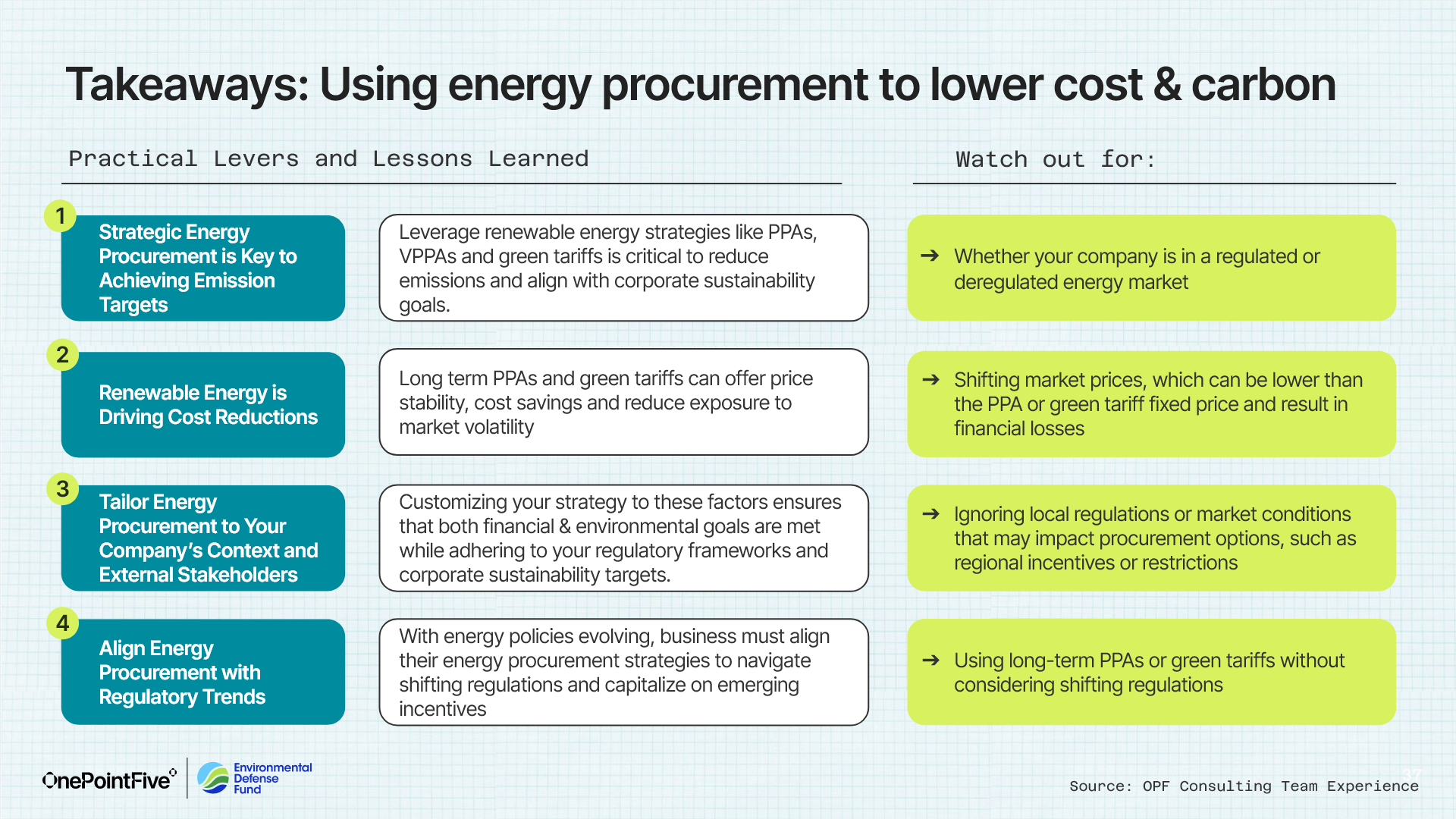
Here are the primary takeaways from the session: a practical walkthrough of energy procurement tools that can be leveraged by professionals and companies to lower both cost and carbon.
Energy demand is rising, and so is renewable opportunity
Global energy demand continues to grow, driven by AI, data centers, and increasing cooling needs as temperatures rise. At the same time, renewable energy’s share of global electricity has climbed to approximately 40% in 2024.
As solar and wind technologies advance and costs decline, renewables are no longer a niche climate solution: they are increasingly a financial strategy. And renewable energy procurement remains one of the most direct levers companies can use to reduce Scope 2 emissions.*
As Matthias reflected:
“We’ve seen a huge trend in increasing energy demand, driven by AI & Data Centers, but also AC to address rising temperatures. We’re going to likely see a big shake up of the market for renewable procurement, as the GHG Protocol and SBTi get closer to releasing their latest standards which prioritize proximity, and hourly matching of energy sources when procuring renewable energy.”
*Scope 2 refers to the indirect emissions generated from purchased electricity, steam, heat or cooling; renewable energy procurement is a Scope 2 decarbonization lever.
Understand where your company stands
A central theme of the session was that there is no one-size-fits-all approach to renewable procurement strategy: it needs to align with company size, geography, market regulation, and risk appetite.
Companies today have multiple procurement pathways available, each with different cost, risk, and emissions implications, including:
Power Purchase Agreements (PPAs), which can secure long-term price certainty while enabling new renewable capacity
Green tariffs, which allow companies in regulated markets to access utility-scale renewables
Renewable energy certificates, which can offer flexibility but may have lower additionality impact.
Direct ownership, which can be more capital intensive.
Matthias mentioned a practical example:
“We shared that 50% of Meta’s renewable strategy is based on green tariffs. While this is possible for a large Fortune 100 company (and a data center Hyperscaler), this is very different from mid-sized company that is more likely to buy renewable energy certificates.”
The challenge for energy-intensive industries
Procurement tools look different depending on how far a sector can electrify. While much of the attention on the future energy system has focused on Big Tech and AI demand, hard-to-abate industries like steel face a fundamentally different challenge.
The steel industry faces structural constraints, and cannot yet fully electrify its operations at commercial scale. Low-carbon steel is technically feasible, but the fuel it requires (such as clean hydrogen) remains limited in supply and cost-competitive availability.
That said, leading companies aren't waiting. Salzgitter, for example, is pursuing near-term decarbonization where possible: signing a 7-year solar PPA and a 15-year wind PPA, aiming to replace their coal-powered furnaces with electrified furnaces for low-carbon steel production, even as the technologies for full decarbonization catch up. This kind of phased approach matters: companies in these sectors need to build internal roadmaps that proactively map out investment, resources, and production requirements, so that clean energy supply is available when the technology is ready to use it.
Regulations are evolving, and strategy must evolve with them
Energy policy continues to shift. In the US, subsidies for solar and wind have faced cuts, while support for nuclear, geothermal, biofuels, and hydro has expanded. But regardless of the policy environment, the economic trajectory of renewables speaks for itself: between 1980 and 2020, the cost of solar fell by 99.6%, wind by 80%, and batteries by 99% (source: The Electrotech Revolution, Ember).
Strategic energy procurement allows organizations to lock in that cost advantage, reduce price volatility, and build a resilient energy strategy — one that will increasingly include renewables as they continue to outcompete on price.
Missed the sessions?
Watch the recordings of the 5-part webinar series for free in the EDF Net Zero Learning Hub.
