
By Narandelger Erdenebileg (Sustainability Associate), Laura Latorre (Sustainability Training & Community Coordinator), Julia Akker (Associate Director), Matthias Muehlbauer (Co-Founder & COO), and Neil Yeoh (CEO & Founder).
Why we measure
As a sustainability advisory firm and climate workforce training organization, OnePointFive believes that accountability starts at home. After measuring our baseline footprint for 2023 emissions, we have set a clear foundation for tracking and reducing our environmental impact.
We have also committed to Net Zero through SME Climate Hub. Back in 2022, Neil Yeoh, our CEO, pledged that OPF will achieve Net Zero by 2030. We recognize how ambitious this goal is, especially after advising our clients on their own sustainability journeys, and encountering both internal and external barriers.
Follow our journey of decarbonization, as we document our wins and challenges on the road to Net Zero. Here’s a look at our organizational emissions to-date.
Executive Summary
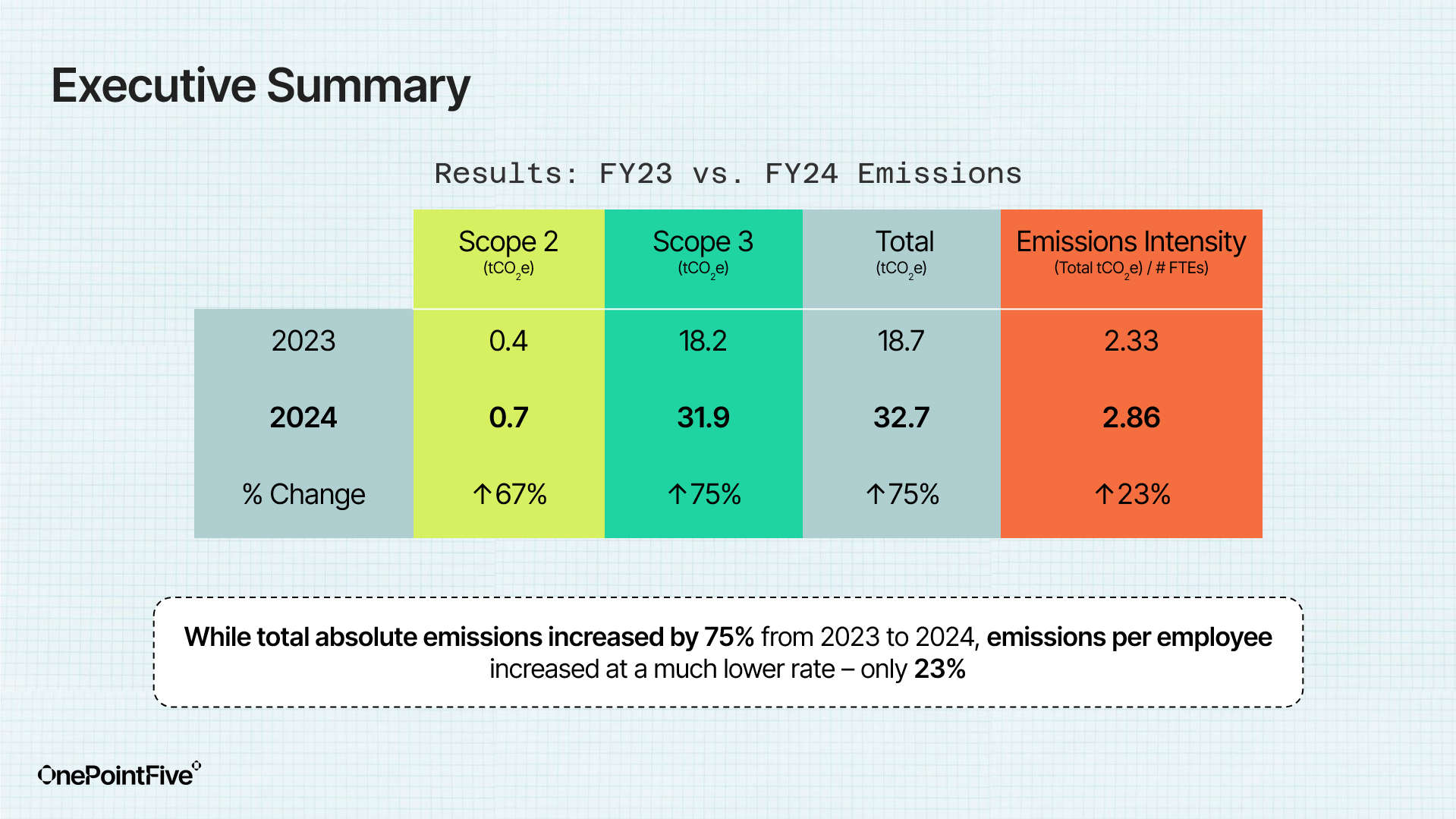
In 2024, OPF’s emissions were 32.7 tCO₂e, which is equivalent to driving 84,291 miles with an average gasoline powered passenger vehicle. This positions OPF in the middle range compared to our sustainability advisory peers.
Although our absolute emissions in 2024 have increased by 75% from our 2023 baseline, our relative emissions considering our full-time-equivalent (FTE) team growth increased by only 23%
This emissions increase in 2024 was driven by our startup & team growth, as well as an increase in business travel as we expanded project delivery into new regions, such as the UK & Asia Pacific.
To address our key hotspots, throughout 2025 we have managed team growth conservatively, reduced non-essential travel, leveraged technology to to scale our impact without increasing our operational footprint.
Our total 2024 emissions
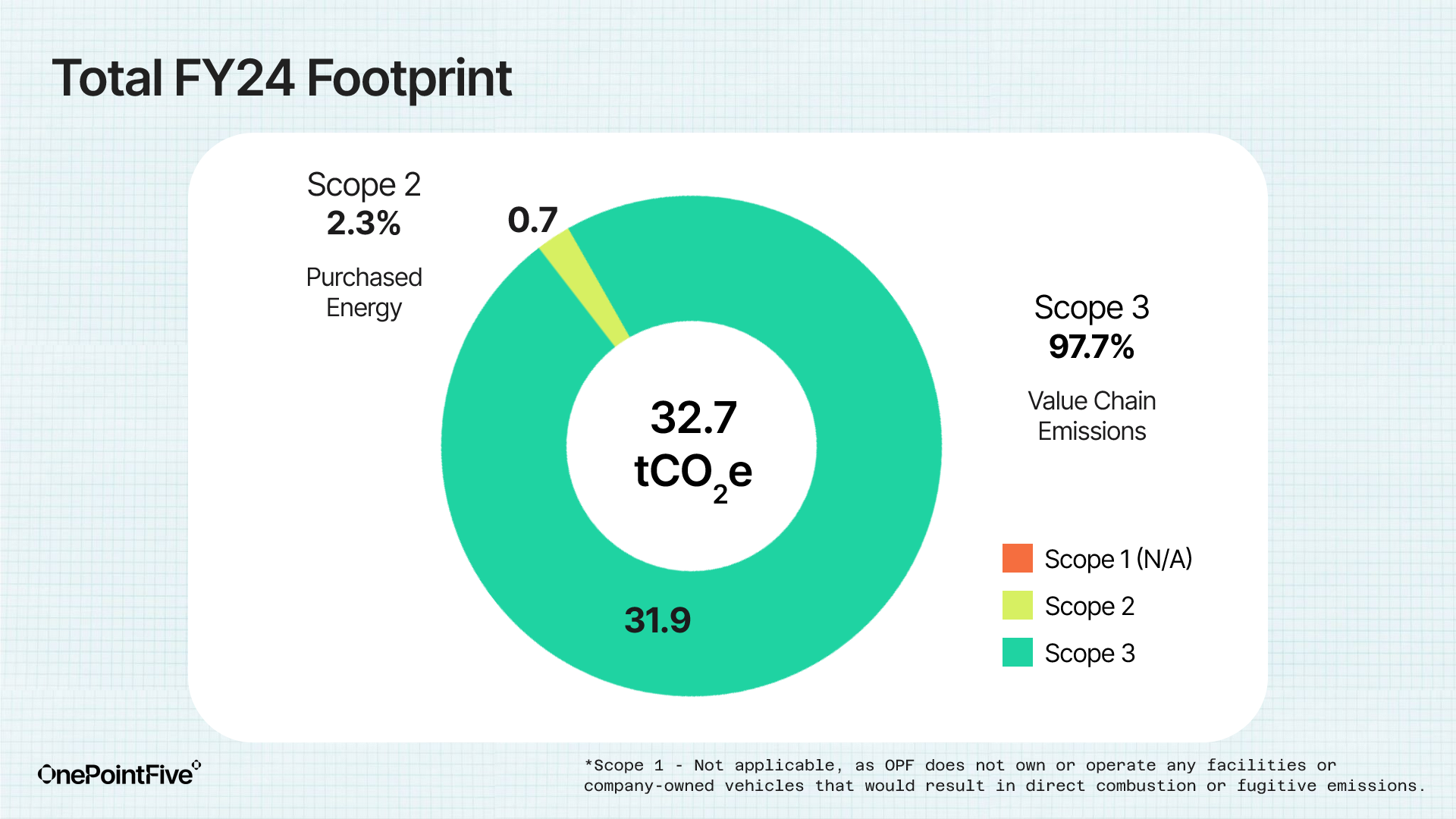
Our total emissions increased from 18.7 tCO₂e in 2023 to 32.7 tCO₂e in 2024. This increase is driven by:
Our expanding team: Our headcount of full-time equivalent (FTE) increased by 43% in 2024!
Office relocation: Our landlord reduced operations in the middle of 2024, forcing a relocation to another building with a less efficient electricity grid. To accommodate our growing team, we moved into a larger office with space for a compact recording studio (which is a key resource for our OPF Academy)! These changes resulted in a 67% increase in Scope 2 emissions.
Travel to client sites and international conferences such as COP29 in Azerbaijan, and higher spend on software & vendor contracting, resulted in a 75% increase in Scope 3 emissions.
To normalize absolute emissions, it’s often helpful to consider efficiency metrics such as emissions per employee or revenue. These indicators are a useful gauge of operational carbon intensity, especially for growth-stage SMEs looking to scale.
As a professional services firm, our team is our biggest asset — operationally, and financially. Despite absolute emissions increasing by 75% in 2024, emissions per employee rose by only 23%, demonstrating that our growth did not translate into a proportional rise in carbon impact.
As OPF continues to grow, holding steady or improving on our 2.83 tCO₂e/FTE benchmark will be a more meaningful representation of our operational intensity than absolute totals.
“As a services company, our Scope 2 emission calculations include electricity from our office space in New York we lease from WeWork. While many companies exclude energy use because it can be argued to be outside their operational control, we have decided to conservatively include it, as we assume managing lighting and offices devices are enough to warrant operational control.” — Matthias Muehlbauer, Co-Founder & COO
Breaking down our hotspots
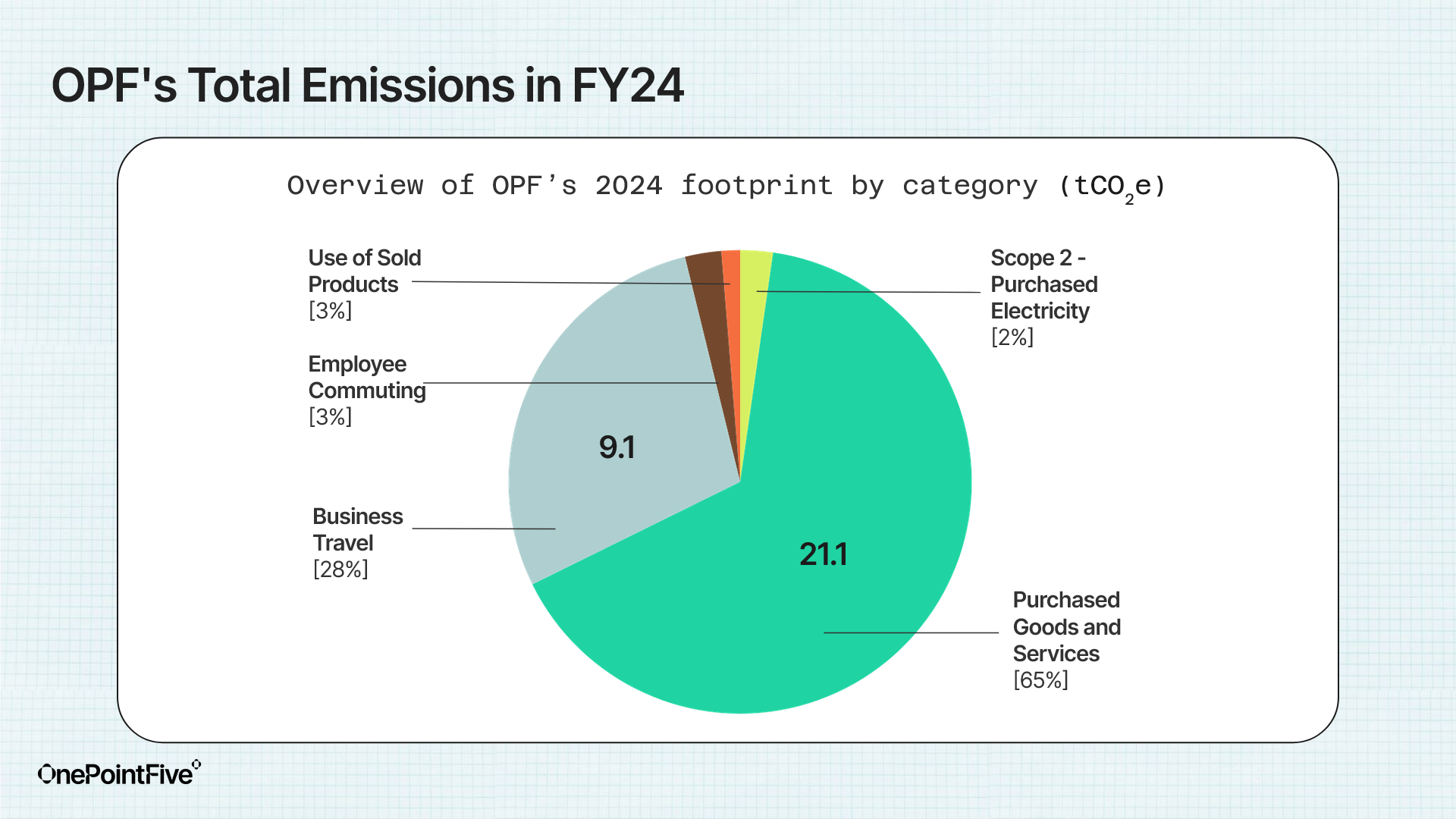
The key emissions hotspots in our 2024 footprint are Purchased Goods and Services (PG&S) and Business Travel emissions.
Purchased Goods & Services
Purchased Goods and Services (PG&S) remains the largest driver of OPF’s Scope 3 emissions, accounting for 65% of our annual footprint in 2024. As a professional services firm, our operations depends heavily on digital tools, cloud infrastructure, and support services.
Within this category, the top contributors are:
Vendor contracting (30%): Including services such as hiring a design agency for our Q3 2024 rebrand, legal fees for trademark application, and more.
Software and applications (26%): Including Notion, Slack, and more.
Meals (22%): Our team thrives on good food and team bonding, with Thursday team lunches at our New York HQ.
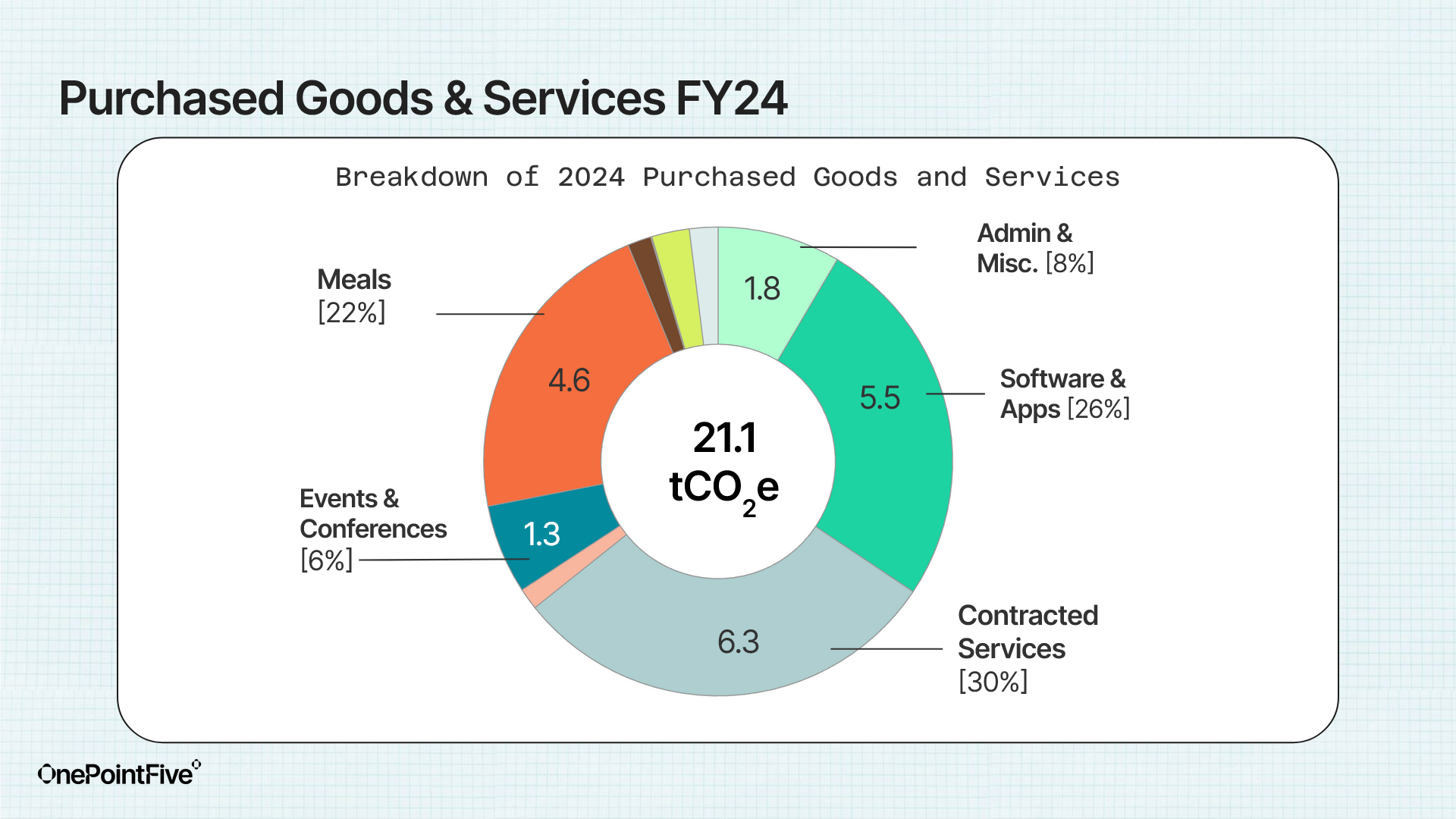
As our business grew in 2024 with more clients, projects, and distributed team operations, so did our reliance on these tools. This expansion led to a 66% year-over-year (YOY) increase in PG&S emissions.
Recognizing this, we continue to streamline our tech subscriptions and evaluate vendors more carefully to reduce unnecessary emissions and improve operational efficiency.
A note on spend-based data
One of the biggest challenges we face is our initial reliance on spend-based data, especially for PG&S, our largest emissions hotspot. While spend-based methods are accepted under the GHG Protocol and useful when supplier-specific or activity data is unavailable, they come with limitations. They are sensitive to price fluctuations, lack operational precision, and often obscure the true drivers of emissions. For hybrid services-based organizations like OPF, spend-based methods may overstate or understate our true activities.
In 2024, we piloted a digital emissions calculation, which combines a spend-based and activity-based approach to capture cloud and website emissions more accurately. This is part of our push to better understand our Scope 3 digital emissions, an area many companies are yet to thoughtfully address with industry methodology still in development. We’ll share a deeper dive in Part 2 of this blog.
Business Travel
Business Travel accounts for 28% of OPF’s total emissions in 2024, making it our second-largest emissions hotspot.
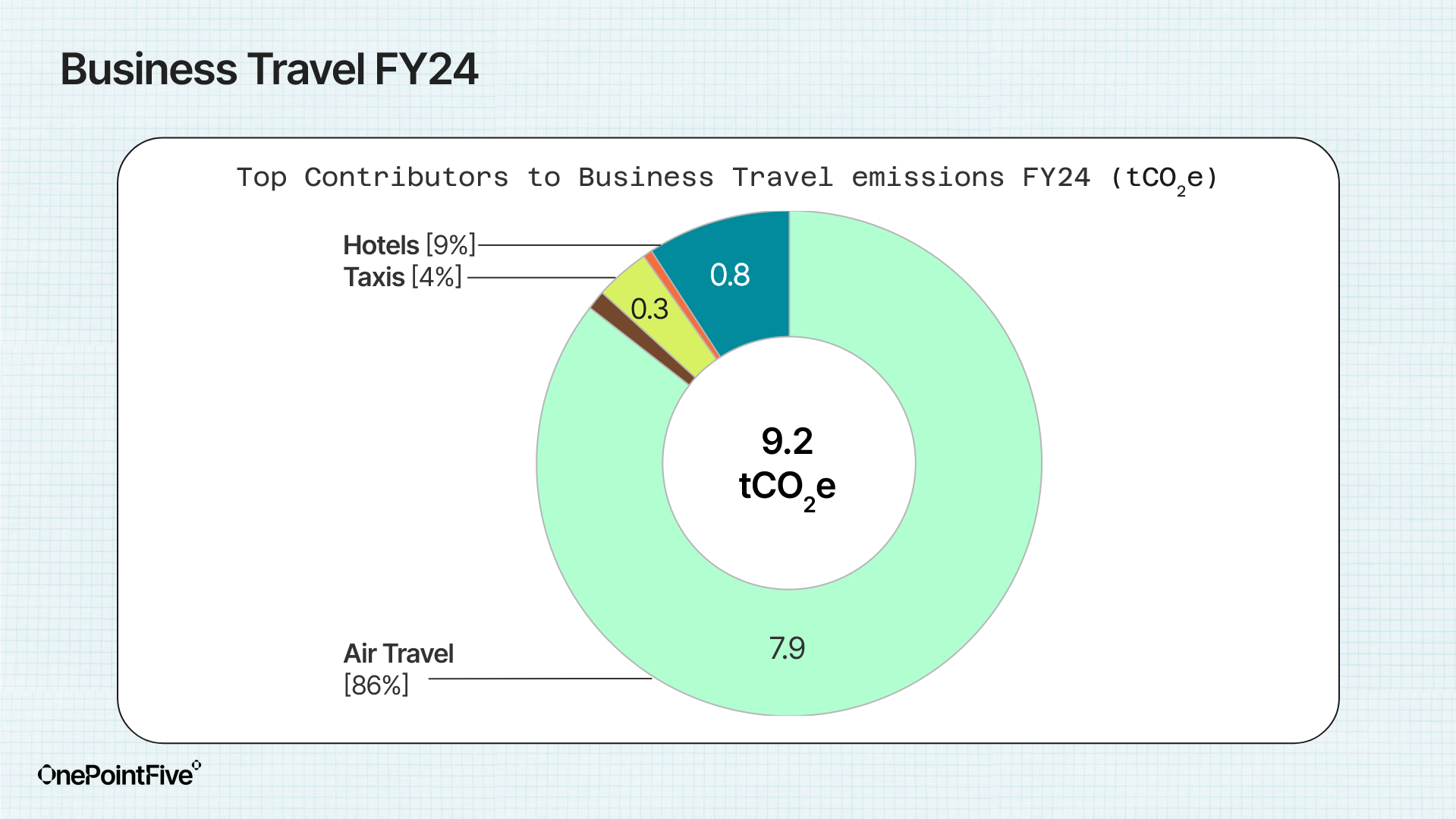
Business Travel emissions doubled YoY, from 4.5 tCO₂e in 2023 to 9.2 tCO₂e in 2024. The majority of these emissions stemmed from delivery of client projects across continents, as well as travel to conferences such as COP29 in Azerbaijan, San Francisco Climate Week, and GreenBiz in Phoenix, as evidenced by a 153% increase in air travel miles and a 35% increase in hotel room-nights. This shift in travel reflects our growing global client base and engagement at key industry conferences.
“Balancing business travel and impact creates natural tension. We try our best to be intentional about our travel: if we absolutely have to travel, we need to be pushing an active leadership, over a participatory role. Just like conferences can become echo chambers and create little additional value, relationships can also accelerate climate progress to get face time with impactful partners that create outsized change.” — Matthias Muehlbauer, Co-Founder & COO
Since inception, OPF has built a digital project delivery model; however, some projects still require in-person meetings, relationship building, and on-the-ground delivery. We have an internal vetting process for event attendance, taking into account strategic importance, impact and emissions.
In 2025, we are reducing conference with internal priorities taking precedence. We have also cut non-essential international travel and reassessed our presence at global conferences, focusing on delivering impact while being conscientious of our flight emissions.
“As we scale into new regions like the UK/Europe and Asia Pacific, we’ll need to be thoughtful about how we travel in the future - i.e. batching trips where possible, reducing how many team members fly, and cutting non-essential flights.” — Neil Yeoh, Co-Founder & CEO
Employee Commuting
While Employee Commuting is only 3% of our footprint, we wanted to thoroughly explore this calculation to fully understand its impact, given we have team members who are hybrid (work remote and in office), and some that are fully remote.
The New York team that commutes to the office solely relies on public transportation. For work-from-home impacts, our methodology included emissions from monitors, laptops, and other home-office equipment, reflecting the real energy profile of distributed work. In addition, we account for differences in electricity grids when calculating work-from-home emissions, considering for situations like an employee in Brazil who works on a much cleaner grid than the one in New York, our HQ.
Benchmarking against our peers
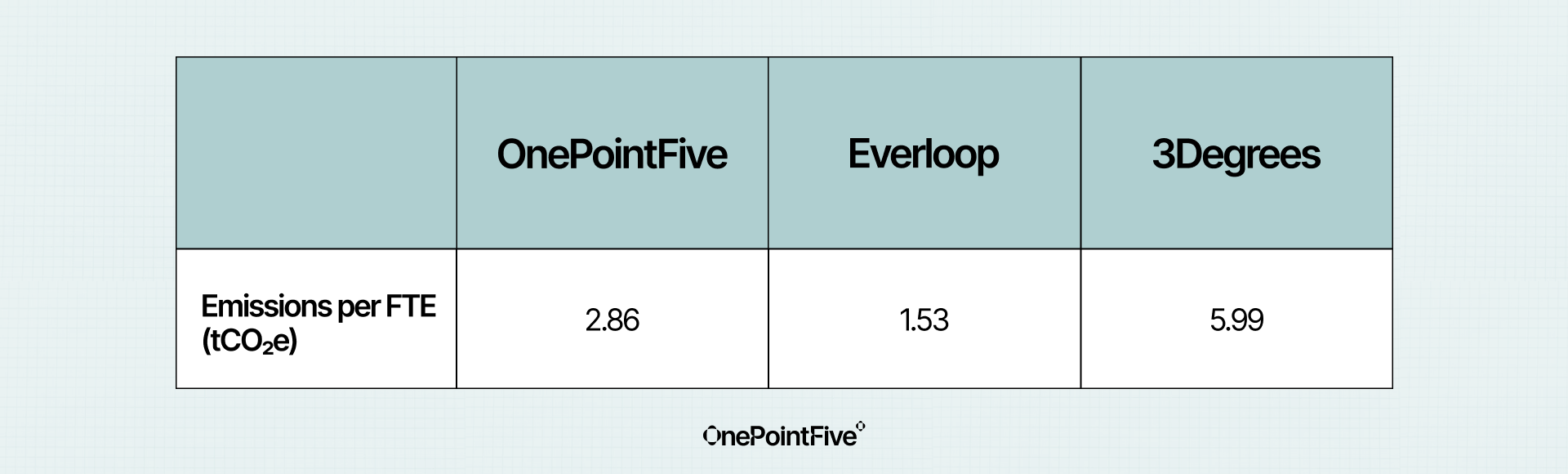
Compared to our peers, OPF’s emissions intensity of 2.86 tCO₂e per FTE sits in a comfortable position. Everloop, a UK-based consultancy with a similar services model, reports 1.53 tCO₂e per employee, demonstrating the impact of lean operations and a fully remote model. Meanwhile, 3Degrees, a hybrid consultancy similar to OPF, with locations across the US, EU, and the UK, comes in at 5.99 tCO₂e per employee. 3Degrees has admirably measured, mitigated, and publicly reported its emissions for nearly two decades — this public accountability sets a standard that we ask our own clients to meet, and is a milestone OPF endeavors to follow.
Looking ahead to 2026 and beyond
To continue strengthening both accuracy and impact, we have identified several methodological and operational improvements to implement in 2026-2027:
Reduce emissions tied to our hotspots
Audit software, apps, and professional service subscriptions regularly to ensure procurement-driven emissions reflect actual usage, and are not inflated by outdated or unnecessary tools.
Formalize a travel policy that prioritizes low-carbon options whenever feasible (e.g., trains over flights, electric vehicles, ride sharing and consolidated trips).
Improve data accuracy
Collect business travel details in real-time by incorporating emissions-related data requests into our existing expense reimbursement portal & process.
Integrate the employee commuting and business travel survey into the off-boarding process for our summer team to eliminate the need for retroactive assumptions.
Explore carbon offsets
Research quality carbon offsets and projects, focusing on those tied to regions and causes that align with our team’s values and global footprint.
“We don’t have all the answers, but its important for us to disclose, improve, and be transparent about our emissions as we make recommendations to our clients, and upskill the climate workforce. We do this not because we’re mandated to disclose, but because we’re aligning our values with our actions, in the hope that it helps others on the decarbonization journey.” — Matthias Muehlbauer, Co-Founder & COO
