Climate Regulations on the Horizon, Part 1: What’s Shifting in North America
By Lucie Paumier (OPF 2026 Summer Sustainability Associate), Elaine Liu (OPF 2026 Summer Strategy Consultant), Laura Latorre (Sustainability Training & Community Coordinator), Abby Dateo (Senior Associate), and Julia Akker (Associate Director), OPF.
You’re reading Part 1 of our “Climate Regulations on the Horizon” series. Explore the full series here
Compared with the rapid growth seen in other markets, the U.S.’s policy landscape has shifted away from broad corporate reporting requirements, with the SEC moving away from mandated climate-related disclosures, even as issue- and sector-specific regulation continues to advance elsewhere. On the other hand, Canada and Mexico show more mixed signals: Mexico has mandated IFRS S1/S2-aligned disclosure for listed companies with first reports due in 2026, while Canada’s CSSB has issued its own aligned standards (CSDS 1 & 2) that remain voluntary after securities regulators paused attempts to mandate them in 2025. What all three governments do have in common is their increasing focus on enabling the infrastructure required for the energy transition and AI economy, whilst simultaneously responding to emerging environmental and public health risks, such as regulating the use of PFAS chemicals.
Plugging into the Future
If there’s one policy conversation happening across North America, it’s energy. The rapid growth of AI and data centers has turned grid capacity into one of the region’s biggest energy and sustainability challenges.
In the U.S., lawmakers are focused on two things: connecting new electricity generation faster, and making sure customers aren’t left paying for the infrastructure needed to support hyper-scale data centers. At the federal level, the proposed Grid Connection and Congestion Management Act, introduced in July 2026, targets the backlog of projects waiting for grid approval, known as the interconnection queue, by letting certain generation projects connect before the necessary transmission upgrades (new or expanded high-voltage lines) are finished. Meanwhile, several states in the US are exploring legislative and utility reforms to ensure large electricity users, like data centers, shoulder a greater share of grid expansion costs.
Canada and Mexico are pursuing the broader goal of building out infrastructure faster, through different mechanisms. Canada is considering reforms to accelerate permitting for nationally significant infrastructure projects. Meanwhile, Mexico has introduced a regulatory framework to integrate battery energy storage systems into the national electricity system, supporting greater flexibility and renewable energy integration.
→ The trend to watch: AI is shaping energy policy in 2026. Expect continued efforts to accelerate grid expansion.
→ The action to take: Start tracking future energy needs and emerging energy policy to strategically evaluate and prepare for climate transition risk.
No More Forever Chemicals
PFAS regulation is gaining momentum in the United States. PFAS, or per- and polyfluoroalkyl substances, were originally introduced in the 1950s. They are long-lasting, manufactured chemicals used to make household and industrial products resistant to heat, oil, stains, grease, and water. Known as “forever chemicals” because they don’t break down in the environment or the human body, PFAS exposure has been linked to certain cancers, thyroid disease, and immune and reproductive effects. The absence of a comprehensive federal framework to understand and control these health and environmental effects has prompted individual U.S. states to advance their own legislation in recent years. These measures span product bans, packaging restrictions, reporting and disclosure requirements, firefighting foam control, drinking water standards, and industrial operations. As a result, companies operating across multiple states face an increasingly fragmented compliance landscape, where regulatory requirements are evolving at different speeds across jurisdictions.
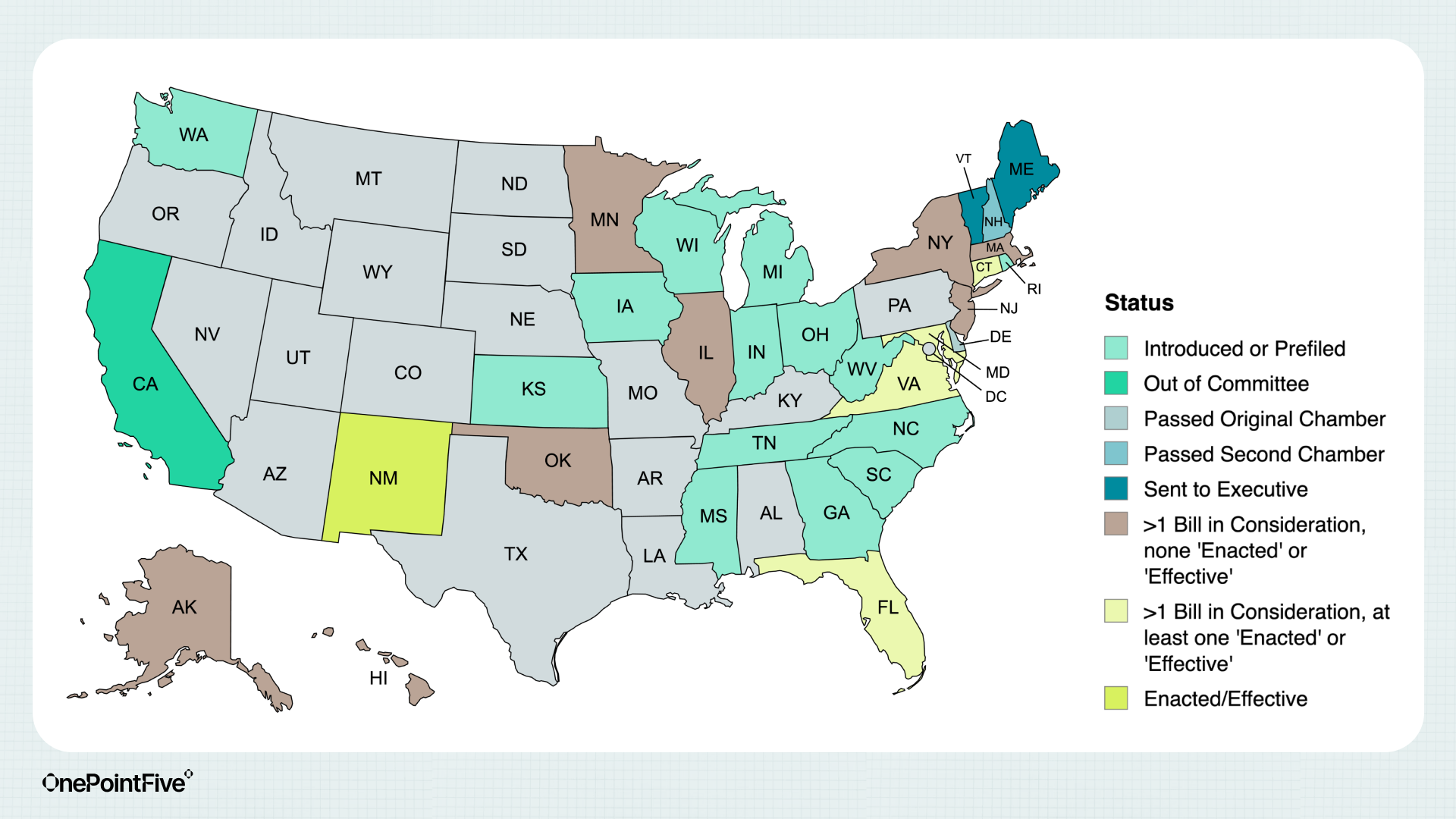
Figure 1: High-level snapshot of U.S. state PFAS legislation. This map is intended to illustrate the breadth of legislative activity, rather than the specific regulatory requirements in each state. Many states have multiple PFAS bills at different stages of the legislative process or addressing different applications. For example, as of August 2026, New York has 22 active bills, New Jersey 12, Illinois 9, and Maryland, Massachusetts, and Michigan each have 6. For the latest legislative status and bill details, refer to the National Caucus of Environmental Legislators’ Policy Library.
Canada is taking a broader federal approach, proposing to manage PFAS as a class of substances under the Canadian Environmental Protection Act. Mexico has yet to introduce comparable nationwide PFAS regulations, but has been modernizing its chemical governance through proposals to reform the General Law of Ecological Balance and Environmental Protection (LGEEPA), which could eventually create pathways for PFAS regulation.
→ The trend to watch: PFAS regulation in the U.S. is becoming another patchwork of state-level requirements. Companies with national operations need to monitor legislation state by state, rather than relying on federal rules.
→ The action to take: Companies selling products containing PFAS should map PFAS exposure across their product portfolio and track requirements state by state.
Resilience as the New Normal
Climate policy isn’t just about reducing emissions anymore. Across the U.S., states are increasingly legislating around the physical impacts of climate change, from protecting workers during extreme heat (Colorado’s HB26-1272 was signed June 4, 2026) to improving flood resilience (Florida’s Senate Bill 302 is effective as of July 1, 2026) to retrofitting homes against severe weather disruptions (Mississippi’s Senate Bill 2409 was passed on April 9, 2026). These policies do not directly tie to long-term decarbonization targets, but rather aim to help communities, businesses, and infrastructure withstand increasingly frequent climate hazards.
Though most of the policy adoption activity is occurring at the U.S. state level, the trend extends across North America. Canada has embedded climate resilience into infrastructure funding, building codes, flood mapping, and disaster planning through its National Adaptation Strategy (announced in 2023; efforts are underway towards a 2026 Progress Report). Similarly, Mexico’s 2026-2030 Special Climate Change Program integrates adaptation (approved June 2026) across sectors including water, agriculture, resilient infrastructure, and disaster risk reduction.
→ The trend to watch: Climate adaptation is moving from planning documents into legislation. Expect resilience requirements, climate risk disclosure, and adaptation planning to become a larger part of environmental policy over the coming decade.
→ The action to take: Assess your exposure to physical climate risks and start integrating adaptation into business continuity, operations, and investment planning.
What’s next for global regulation
This is the first in a three-part series on the sustainability regulations shaping global business in 2026. Next, we'll turn to the EU and UK, where supply chain accountability and green-claims enforcement are accelerating; followed by Asia-Pacific, where sustainability disclosure adoption is moving fastest of all.
Subscribe to our newsletter for the rest of the series and more updates on sustainability regulations around the world.