From Climate Risk to Business Action, Part 1: The Foundations
By Julia Akker (Associate Director), Victoria Thompson (Senior Associate), Laura Latorre (Sustainability Training & Community Coordinator) and Narandelger Erdenebileg (Sustainability Associate)
According to World Economic Forum’s Global Risk Report (2026), climate risk is widely recognized as a top threat over the next decade. However, framing climate risk as solely a future concern, rather than a current one, can be detrimental. Increasing droughts, wildfires, flooding, as well as tightening sustainability regulations, are already impacting every sector by reshaping operating costs, asset values, supply chain stability, and market expectations.
And yet, for many organizations, climate risk still sits outside their core business strategy, treated as a reputational concern or deferred to future reporting cycles, rather than a present-day business risk. This gap between awareness and action is where financial exposure grows, and the threat of actual climate risk-related losses increases.
This is Part 1 of our From Climate Risk to Business Action series. We start with the foundations: what climate risk actually is, the different types every business faces, and why acting now is a business imperative..
What is Climate Risk
According to the UN Intergovernmental Panel on Climate Change (IPCC):
“Climate risk is the potential for climate change to create adverse consequences for humans, businesses, and ecological systems.”
That includes impacts on livelihoods, health and wellbeing, economic and cultural assets, infrastructure, services, ecosystems, biodiversity, and species. For businesses, this translates directly into exposure that affects operations, costs, revenue, and long-term asset value.
The Two Types of Climate Risk
The Task Force on Climate-related Financial Disclosures (TCFD) Framework, which has been rolled into the International Financial Reporting Standards (IFRS) S1 & S2 standards, groups climate risks into two types: physical risk and transition risk.
Physical climate risks
Physical climate risks refer to the potential for damage or destruction of physical assets caused by both extreme weather events and the gradual, longer-term effects of climate change. They come in two forms:
Acute physical risks are sudden, high-impact events, such as hurricanes, floods and wildfires. These can disrupt operations overnight, damage infrastructure, and force business continuity decisions for which organizations are often unprepared.
Chronic physical risks are slow-building, structural shifts in climate patterns; examples include drought, sea level rise and heat stress. For businesses, these changes can affect supply chains, infrastructure, and the long-term viability of assets in vulnerable locations.
Transition climate risks
Transition risks are not directly tied to weather events and shifts, but rather from how economies, policies, and markets are shifting away from fossil fuels and toward a low-carbon economy. These risks are typically grouped into four types:
Policy & Legal risks are driven by new or evolving climate related regulations, carbon pricing mechanisms or taxes, and legal liabilities
Technology risks stem from lower emissions technologies replacing companies' existing products, the associated costs of transition, and/or companies' failure to invest
Market risks arise from supply chain disruptions, volatility in commodity and raw material costs, and shifting customer behavior and investor demands towards low-carbon alternatives
Reputation risks include public scrutiny, stakeholder concerns, and the growing expectations of employees, investors, and partners, especially for companies that remain tied to the fossil fuel economy
The global direction toward a low-carbon economy continues despite recent geopolitical uncertainty and shifting climate policy landscapes in some regions. Companies that treat policy shifts as a signal to pause sustainability efforts take on greater risk, as pausing creates capability gaps: teams lose momentum, slowing process and weakening internal capabilities over time. When policy tightens again, these organizations must rebuild from scratch, at higher cost and with less time to respond.
Thus, most companies are not pulling back. As of 2025, 87% of U.S. companies have maintained or increased sustainability investment, and 88% of global companies view sustainability as a source of long-term value. Only 3% report reducing sustainability communications or initiatives over the past year.
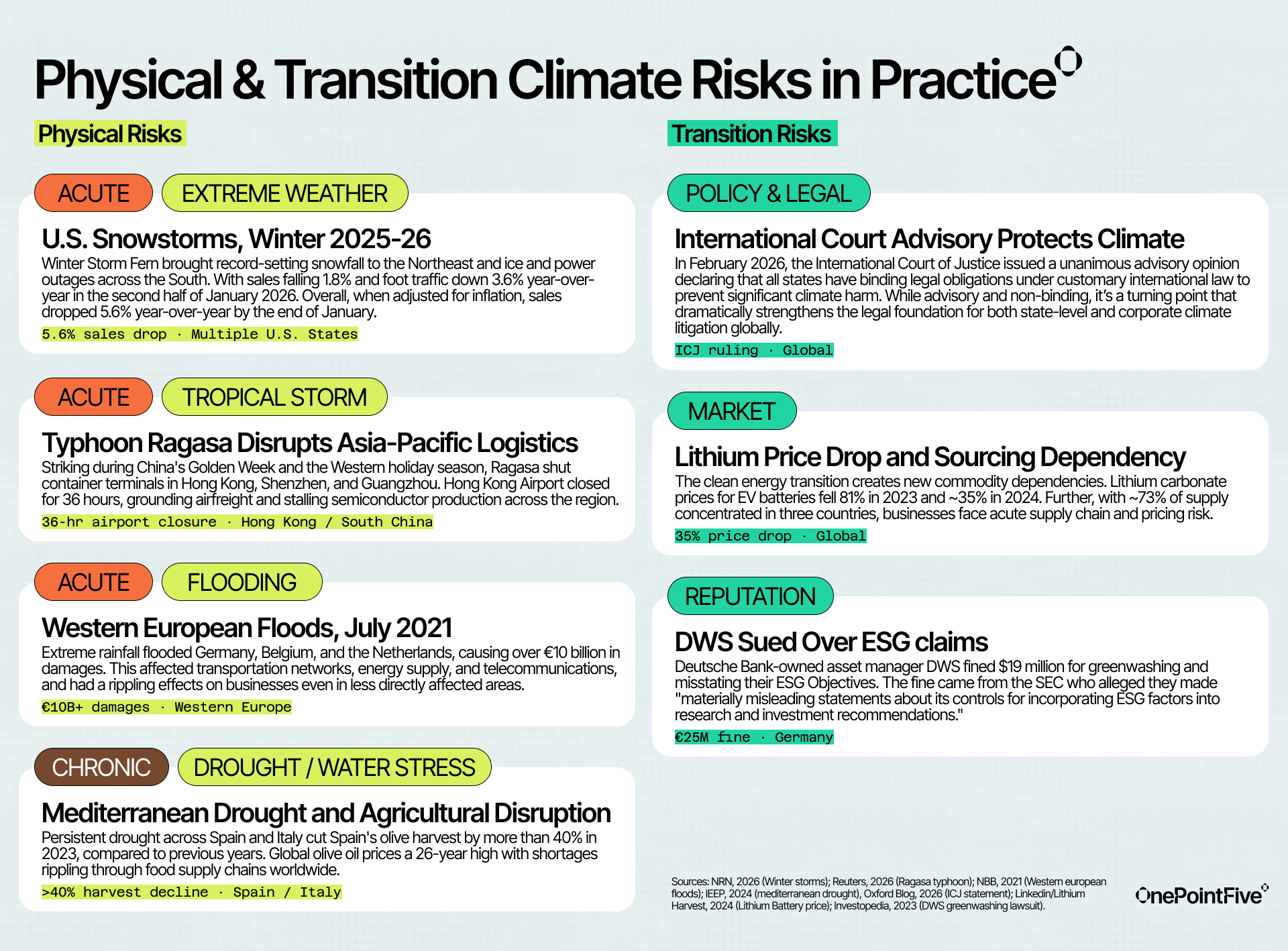
Sources: NRN, 2026 (Winter storms); Reuters, 2026 (Ragasa typhoon); NBB, 2021 (Western european floods); IEEP, 2024 (mediterranean drought), Oxford Blog, 2026 (ICJ statement); Linkedin/Lithium Harvest, 2024 (Lithium Battery price); Investopedia, 2023 (DWS greenwashing lawsuit).
Why Should Businesses Care About Climate Risk?
Physical and transition risks can have a variety of impacts on businesses, communities, the environment, and the global financial system at large. For businesses specifically, these primarily include financial and regulatory exposures. We’ll focus on risk for now; however, it's important to note that climate risks are often accompanied by climate opportunities.
Climate risk increases financial exposure, threatening business assets and generating sudden costs
Climate-related disasters caused an estimated $417 billion in global economic losses in 2024 alone. Without urgent investment in resilience, global GDP could shrink by up to 10% by 2050, with developing countries absorbing the steepest losses and climate impacts.
Corporations face a similar trajectory. Projected annual losses from climate hazards for S&P 500 companies are expected to nearly double between now and the 2090s. These costs compound year-over-year, representing a material financial risk. But awareness is uneven, 83% of European companies with adaptation plans acknowledge that climate change is likely to have a financial impact on their operations, compared with much lower rates elsewhere. Yet even among companies that recognize the risk, only about a quarter integrate climate risk analyses into their financial planning. That disconnect is where the exposure quietly grows.
Asset prices are not reflecting risk
Climate risk is not yet fully reflected in asset prices, leading to a growing disconnect between market perceptions and actual value.
MSCI’s 2024 survey of asset owners, managers, banks, and insurers reveals that nearly half (48%) of investors believe climate risk is entirely absent from asset pricing, with 41% saying it is only partially considered. Most expect repricing to occur gradually, with only 5% of respondents indicating that climate change had a major effect on their asset allocation.
This creates a mispricing problem. Asset values continue to assume stability, even as exposure to both physical and transition risks rises. We already see this dynamic in real assets: a U.S. study comparing flood risk data with property prices found that 3.8 million homes in flood-prone areas are overvalued by $33 to $56 billion; mispricing was lower in states with stronger disclosure requirements, where sellers must communicate flood risk and prices better reflect underlying exposure. But progress is uneven. Recently, Zillow, the largest real estate platform in the U.S., removed a feature that displayed property vulnerability to climate change. The decision followed backlash from industry stakeholders and homeowners, who argued that this feature was negatively impacting property sales.
As climate risks become more measurable and transparent, markets will inevitably adjust. For companies with high physical or transition exposure, this is likely to result in lower valuations. For others, improved transparency may reduce uncertainty or reveal transition advantages.
The insurance floor is disappearing
One of the most immediate and clear consequences of physical climate risk is the growing uninsurability of assets. The "protection gap", which is the share of economic losses from natural catastrophes that go uninsured, is increasing.
An article by EDF shared how California is rapidly becoming uninsurable as insurers like State Farm, Allstate, and Nationwide flee the market, particularly in fire-prone areas. This comes after the 2017–2018 wildfire seasons wiped out 32 years of accumulated underwriting profits, driving a 70% reduction in policies in very high-risk zones; this was intensified even further by 2025’s fires.
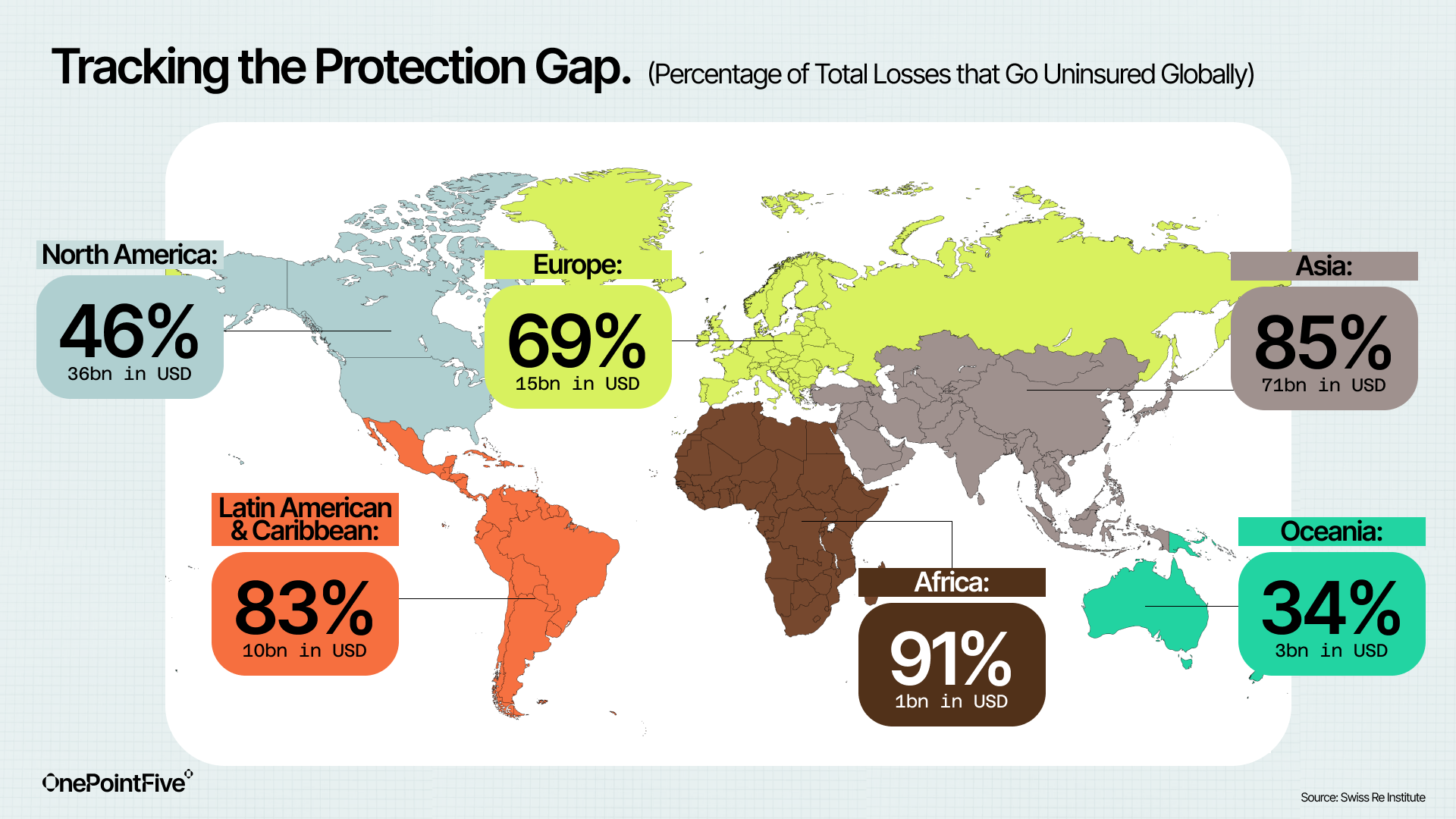
Source: NatCap Protection Gap 2010-2019, Swiss Re Institute
When insurance withdraws from high-risk geographies and asset classes, the financial burden falls directly onto businesses and communities. Under-insurance leaves recovery efforts underfunded and organizations exposed to losses with no safety net.
Businesses need to stay ahead of standards and regulations
Regulatory pressure is a critical driver for companies to assess their climate risk. Two major frameworks are currently reshaping disclosure expectations:
IFRS S2: Climate-related Disclosures requires companies to assess and disclose physical and transition risks, industry-specific climate metrics, related financial impacts, and Scope 1, 2, and 3 emissions. It was finalized in June 2023 and became effective January 2024. While voluntary in the U.S., it has been adopted in 21 jurisdictions worldwide, including but not limited to: Canada, Brazil, Australia, Mexico, and Chile.
California's SB 261: Climate-related Financial Risk Act imposes a mandatory evaluation and public disclosure of physical and transition risk for companies with >$500 million USD in revenue. While currently paused due to a legal challenge brought by the US Chamber of Commerce and other business groups, the scope includes companies that do business in California, regardless of domicile; as a result, this effectively becomes a de facto requirement for many large companies given the revenue requirements. This and other California legislation are also shaping broader regulatory momentum, with several other U.S. states (e.g. New York and New Jersey) advancing similar climate disclosure requirements.
Climate regulations are becoming baseline business practice. Other notable climate regulations to look out for are:
UK Sustainability Reporting Standards (SRS) S2 Climate-related Disclosures: Currently voluntary standards for companies to disclose climate-related risks and opportunities. However, there are ongoing consultations on the potential for mandatory adoption for certain companies, including considerations on scope and timing, with a proposed reporting period beginning in 2027.
European Union Directive on Empowering Consumers for the Green Transition (ECGT): Mandatory directive for businesses to take proactive measures to ensure that their explicit environmental claims are accurate, transparent, and backed by credible evidence. These rules will apply to businesses starting September 2026.
European Union Corporate Sustainability Due Diligence Directive (CSDDD): Now part of the Omnibus directive, it mandates companies to conduct appropriate human rights and environmental due diligence, with a rolling compliance timeline starting 2027 and in full force in 2029.
Australian Accounting Standard Board (AASB) S2 Climate-related Disclosures: Mandatory standard for companies meeting specific requirements to disclose information about their climate-related risks and opportunities. Enforcement is phased, largest entities having their first annual reporting period beginning January 2025, and smaller entities following in subsequent years.
There are new market opportunities to lead the net zero transition
The climate transition isn't only a source of risk, it's also a competitive advantage for organizations that move proactively. That advantage shows up in two distinct ways: access to fast-growing markets, and alignment with the stakeholders who will shape the next decade of demand — Gen Z and Millenials.
Fast-growing markets
According to Singaporean sovereign wealth fund GIC, adaptation and resilience investments could present a significant opportunity for investment: $9 trillion by 2050. Moreover, GIC's analysis suggests 2050 revenues will exceed historical forecasts since most financial analysts still rely on historical data, rather than climate science when modeling future demand. For proactive organizations, this gap between forecasts and physical reality is precisely where early-mover advantage lives.
Capital is already moving at scale. BloombergNEF found that global energy transition investment hit a record $2.3 trillion in 2025, up 8% from the prior year.
The next decade of demand
The stakeholder opportunity is equally concrete. Consumer preferences are shifting, surveys including Deloitte's 2025 Gen Z and Millennial Survey and the OpenText Survey show younger generations increasingly weighting sustainability, transparency, and ethics in their purchasing decisions. The same values shape where they choose to work: 89% of Gen Zs and 92% of millennials say a sense of purpose is important to their job satisfaction; making sustainability leadership a lever for talent attraction as much as customer acquisition
What Comes Next
Understanding climate risk is the first step. The next challenge is determining which risks matter most, how they could impact your organization, and what actions to take in response.
Continue with Part 2: Climate Risk Analysis & Management, where we explore practical frameworks for assessing, prioritizing, and integrating climate risks into business decision-making and risk management processes.
Download the free guide to access practical tools, a real-world case study, and actionable approaches for turning climate risk awareness into business resilience.