OPF Supports ASME to Complete Their Full Scope 1-3 GHG Accounting
By Abby Dateo (Senior Associate) and Julia Akker (Associate Director)
Client Challenge
OnePointFive supported the American Society of Mechanical Engineers(ASME) to complete its baseline Scope 1, 2 & 3 emissions calculations, establishing ASME as one of the first North American engineering societies to do so.
While Scope 1 & 2 emissions from ASME’s five global officeswere previously calculated, ASME required support to update the initial Scope 1 & 2 results and capture its more complex Scope 3 footprint. Scope 3 represents ASME’s indirect emissions generated from its 400+ employees, 70,000+ member stakeholder network, procurement activities, travel, and 100+ annual events. Quantifying these emissions required a custom approach and a software solution. The software solution further had to meet ASME’s IT requirements, including security and interoperability with existing systems.
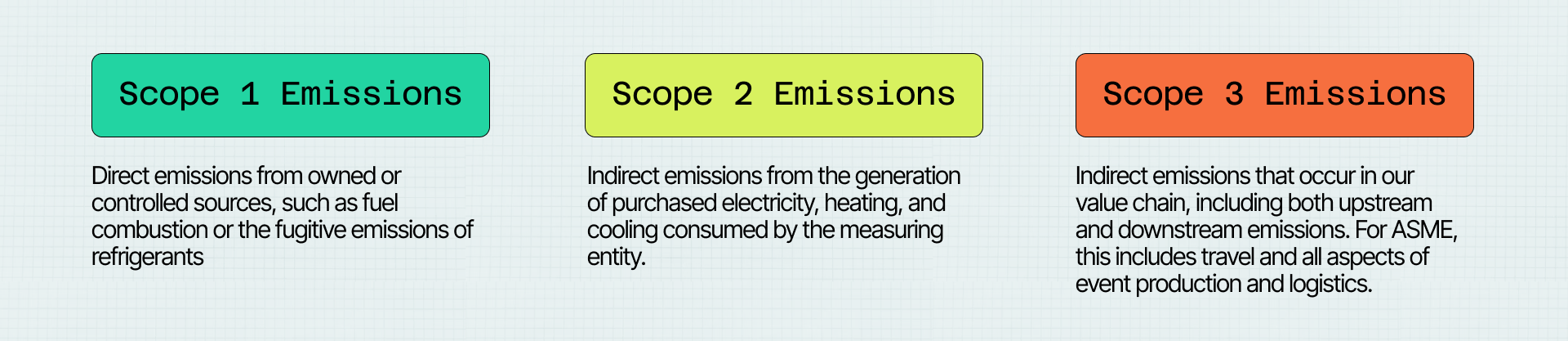
Scope 3 definitions courtesy of ASME
OPF’s Solution
Identified 11 emissions categories across Scope 1-3 to include in calculations
OPF identified refrigerants and purchased electricity as ASME’s direct Scope 1 & 2 sources.
For Scope 3, OPF conducted 40+ interviews with stakeholders across eight ASME Business Units (BUs) to identify which of the 15 categories defined by the GHG Protocol were material to ASME’s footprint. A category is deemed material if its exclusion from calculations would compromise the credibility or interpretation of the baseline results; eight categories met the threshold.
While events are not formally recognized under the 15 Scope 3 categories in GHG Protocol, stakeholder interviews and ASME's 100+ annual events made it likely to be a potential emissions hotspot. We therefore defined events as a custom category to ensure these emissions were measured and managed appropriately.
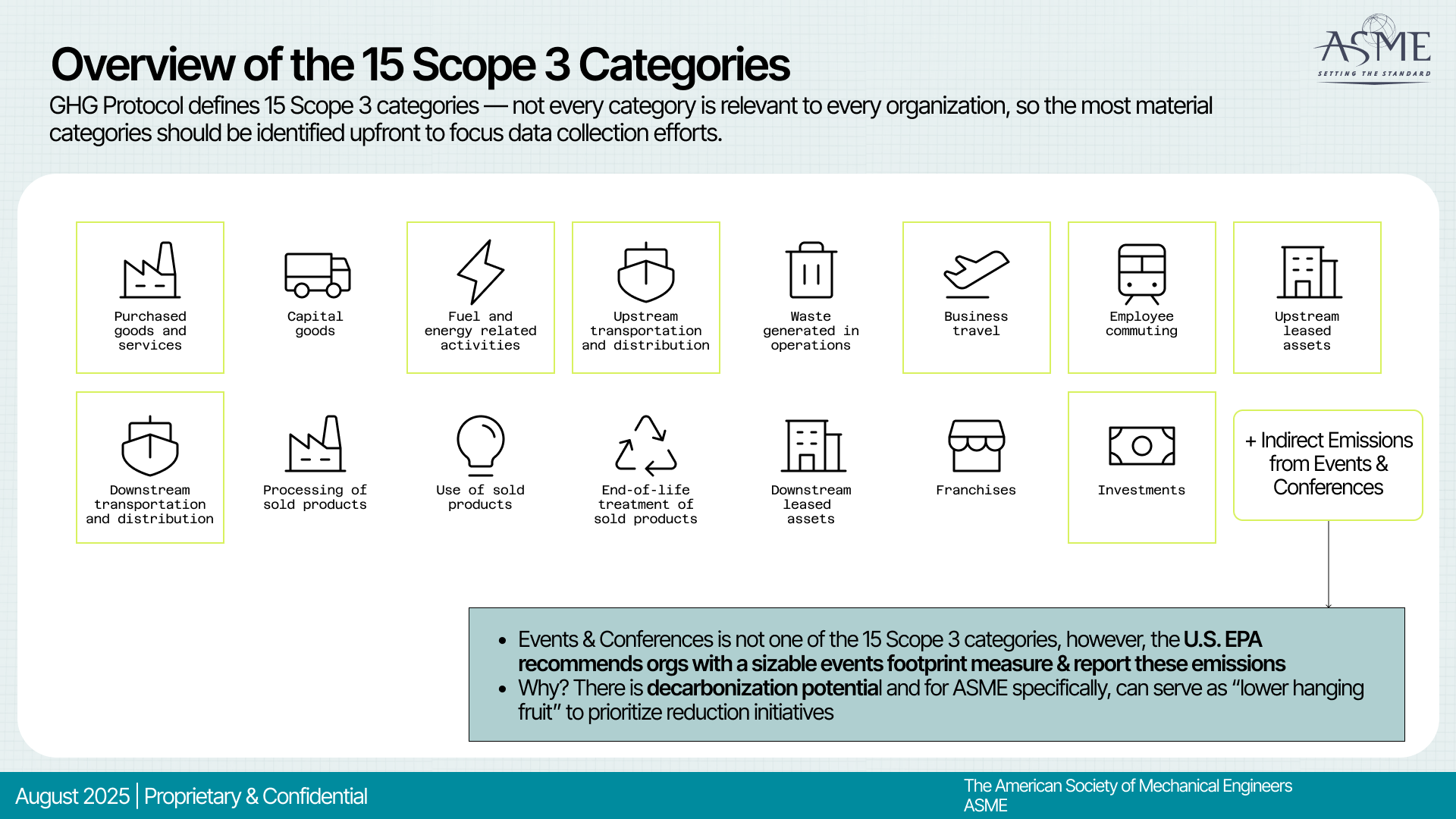
In lime: categories included in ASME’s footprint. Overview of the 15 Scope 3 Categories courtesy of ASME
Mapped Scope 3 data and developed custom events methodology
Given ASME's size and the complexity of Scope 3 data, the organization needed a scalable carbon accounting platform to manage both baseline calculations and future reporting. OPF supported the IT and Procurement teams in selecting Salesforce’s Agentforce Net Zero Cloud (NZC) following a detailed evaluation of five platforms against 100+ technical and operational criteria.
In the same 40+ stakeholder interviews, OPF identified available data inputs across all emissions categories and data owners across each of the eight ASME BUs. OPF used key insights on data available and data owners to inform the technical setup of Agentforce NZC. Because the software required significant customization, OPF led platform architecture design to align with ASME’s data availability and Scope 3 requirements. This included developing a tailored framework for ASME event owners to estimate energy use for major in-person conferences where standard data (e.g. kWh usage) was unavailable.
This methodology revealed that event-related activities accounted for 587 tonnes, or 15.6% of ASME’s Scope 3 emissions, highlighting a primary area for reduction. (ASME, Sep 25, 2025)
Liaised data upload and calculation efforts to build capacity and drive long-term GHG governance
To ensure long-term independence, OPF trained ASME’s internal BUs, with a particular focus on the sustainability team, to collect and calculate Scope 1-3 data for future fiscal years. This included developing training decks, leading collaborative working sessions on data uploads, and collaborating on User Acceptance Testing (UAT) to validate the Salesforce NZC build. OPF further defined user roles and permission sets to integrate ASME stakeholders directly into the platform's governance structure. To formalize this work, OPF informed the development of an operating charter and reporting protocols for variable sustainability governance groups. This comprehensive hand-over, documented through process guides and lessons learned, equips ASME to manage ongoing reporting and future decarbonization strategies independently.
Key Outcomes
✅ Developed 15-item scoping questionnaire to define operational boundaries
✅ Defined 11 categories across Scope 1-3 to include in FY23 baseline emissions
✅ Captured 4,000 tons of emissions data
✅ Identified procurement (81%) and events (16%) as major Scope 3 emission hotspots
✅ Delivered internal training for year-over-year Scope 3 emissions tracking
✅ Documented the full Scope 3 process to support long-term emissions management by ASME’s internal sustainability team
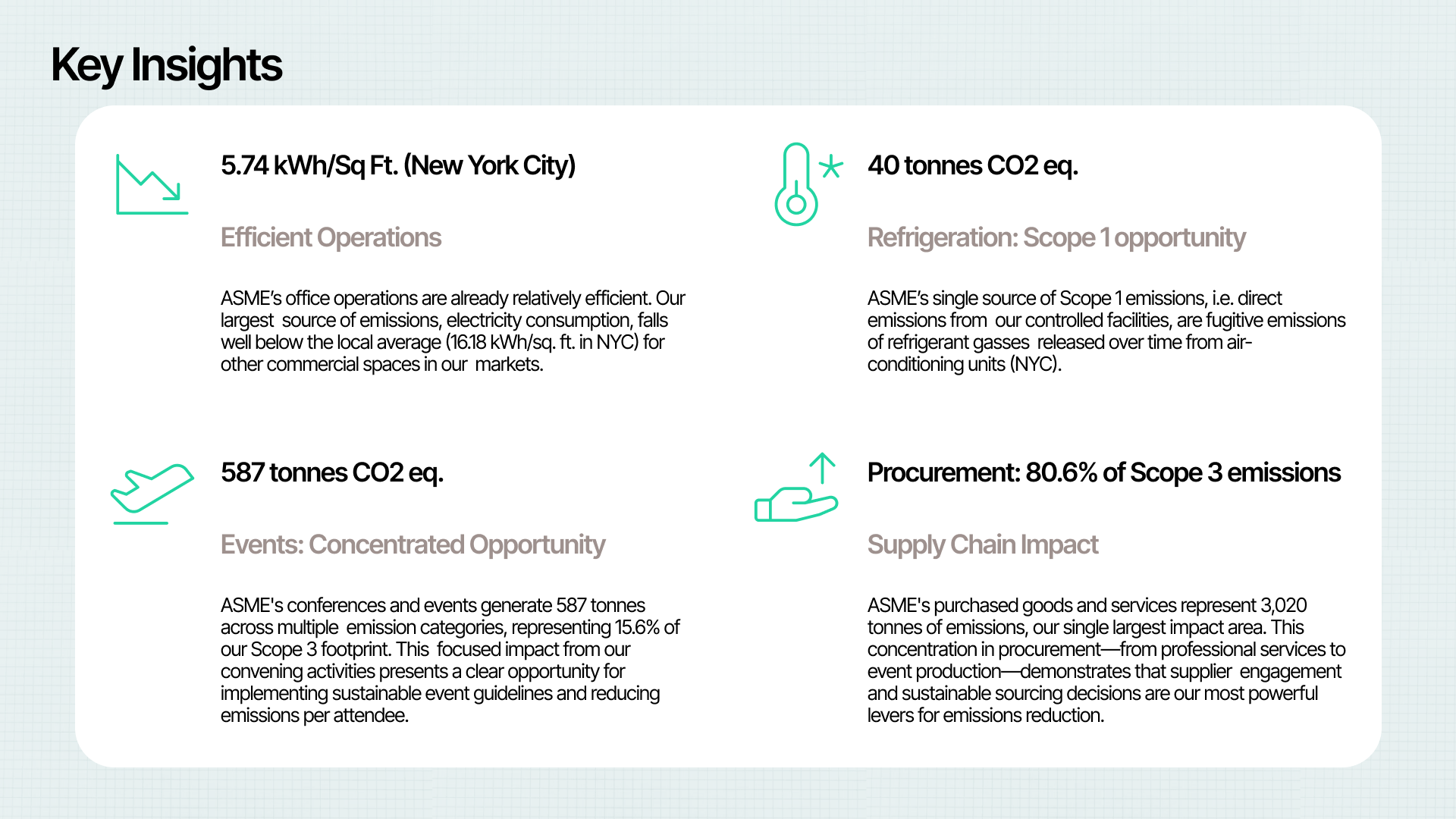
Key Insights courtesy of ASME
Read Part 2: From Baseline to Automation
This project marked the first phase of ASME’s sustainability journey: establishing a complete, credible Scope 1–3 emissions baseline. In Part 2, we share how OnePointFive supported ASME in implementing Salesforce Agentforce Net Zero Cloud to automate Scope 3 tracking and build repeatable governance processes.