
Master the Economics and Strategy of Corporate Decarbonization
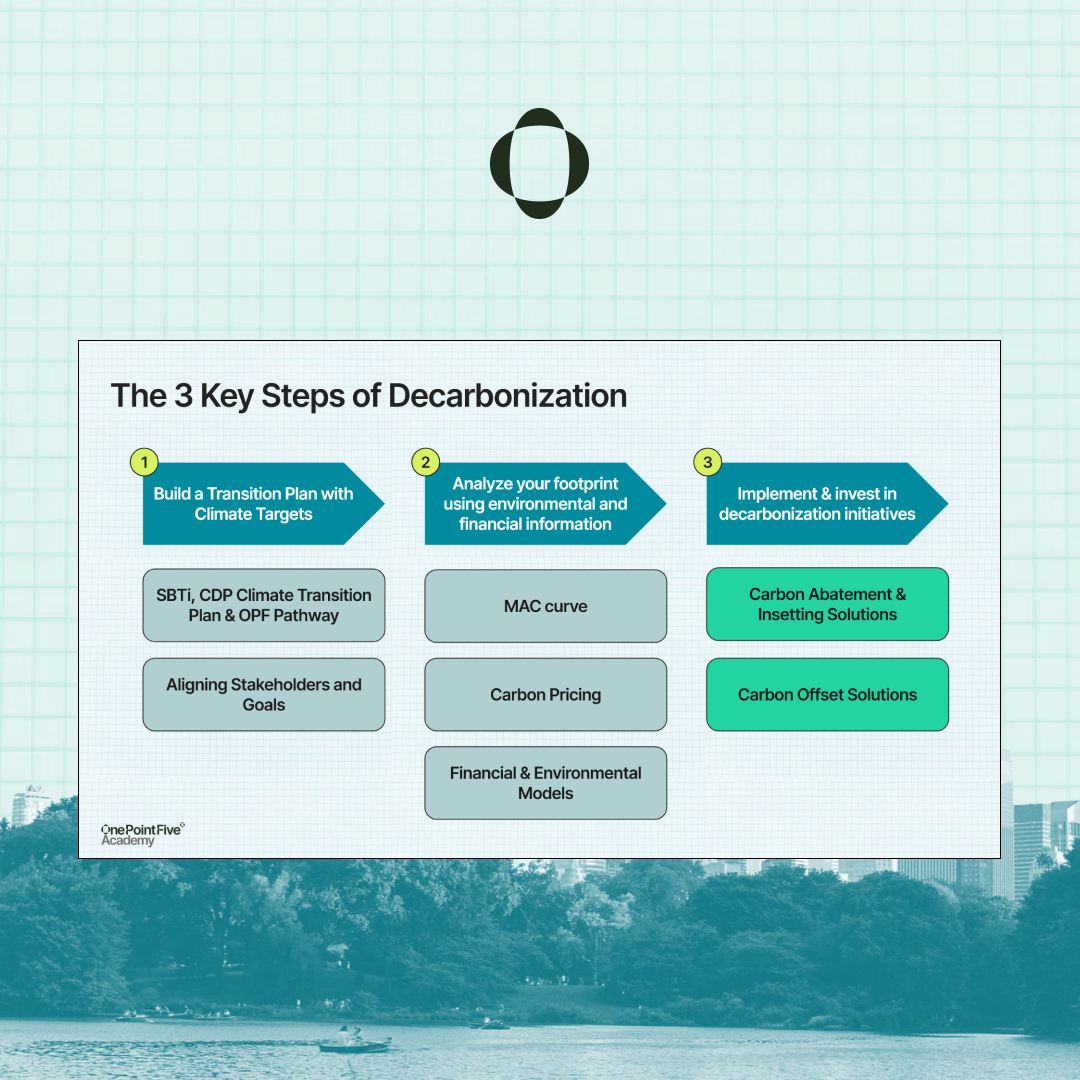
Move beyond climate commitments and drive real-world emissions reductions. This module equips professionals to evaluate decarbonization opportunities through economic lenses, focusing on key tools such as: marginal abatement cost curves to sequence initiatives; internal carbon pricing to drive decision-making; and understanding carbon markets as both compliance mechanisms and investment opportunities. Your workforce will learn to build financial and environmental models that demonstrate how decarbonization creates business value while achieving Net-Zero goals.
This strategic training is designed for teams who need to:
Translate organizational emissions data into prioritized reduction roadmaps with clear ROI
Evaluate decarbonization initiatives based on cost-effectiveness and abatement potential
Implement internal carbon pricing mechanisms (shadow pricing, internal fees, or carbon taxes)
Build financial models that integrate environmental and business outcomes
Navigate voluntary and compliance carbon markets with strategic insight
Understand investment principles for decarbonization projects and climate solutions
Assess emerging market mechanisms including carbon removal credits and nature-based solutions
Sequence decarbonization interventions to maximize impact within budget constraints
Your pledge needs an economic toolkit
Companies have spent years measuring emissions, but the gap between commitments and execution remains vast. While 80% of FTSE 100 companies have net-zero pledges, only 5% have credible transition plans. The market opportunity for climate solutions is projected at $9-12 trillion annually by 2030, but realizing this potential requires investing capital strategically toward high-impact decarbonization initiatives. Teams who can apply marginal abatement cost curves, integrate carbon pricing into decision-making, and navigate carbon markets will position their organizations to lead: reducing costs, accessing green capital, and building competitive advantage in the Net-Zero economy.
Learning outcomes
By completing this module, your team will be able to:
Define corporate decarbonization and identify leading trends across industries and sectors
Construct and interpret Marginal Abatement Cost Curves (MACCs) to prioritize reduction initiatives by cost and impact
Explain the differences between carbon tax, internal cost of carbon, and shadow pricing mechanisms
Apply internal carbon pricing to evaluate capital investments and operational decisions
List the core principles of investment into decarbonization projects (payback period, NPV, carbon ROI)
Design basic financial and environmental models that integrate emissions reductions with business metrics
Distinguish between compliance carbon markets (cap-and-trade) and voluntary carbon markets
Identify the key players across the carbon markets value chain: project developers, registries, brokers, buyers
Evaluate carbon credit quality standards and understand emerging trends in carbon removal (nature-based and engineered)
Sequence decarbonization interventions strategically to balance quick wins with long-term transformation
Optional add-ons
2-3 hour Labs: Build a MACC for your organization and develop internal carbon pricing scenarios
1-2 hour Workshops: Industry-specific decarbonization workshops focused on sector-specific pathways (manufacturing, tech, logistics, etc.)
Module details
Duration: 2-3 hours total learning time
Materials: Video content, MACC examples, carbon pricing case studies, carbon market overviews, financial modeling templates, downloadable resources
Prerequisites: Modules 2 (GHG Accounting) and 4 (Sustainability Reporting) recommended to understand baseline emissions and the broader context for decarbonization commitments |Designed to build on measurement and disclosure concepts
