
Master Sustainability Reporting in an Era of Mandatory Disclosure
Transform regulatory compliance into strategic opportunity with comprehensive training on the rapidly evolving sustainability reporting landscape. This module equips professionals to navigate the convergence of global disclosure standards, from IFRS S1 & S2 to regional mandates like California's SB-253 and the EU's CSRD. Your workforce will understand how to select the right frameworks, identify material topics, report credible metrics, and position sustainability transparency as a driver of business value, investor confidence, and stakeholder trust.
This essential training is designed for teams who need to:
Understand mandatory climate disclosure requirements across jurisdictions (California, EU, UK, and emerging global standards)
Navigate the alphabet soup of frameworks and standards (IFRS, TCFD, GRI, SASB, CDP) and understand how they work together
Identify which disclosure requirements apply to your organization based on size, industry, and geography
Report material sustainability metrics with credibility and avoid greenwashing risks
Align sustainability reporting with financial reporting and investor expectations
Respond to increasing stakeholder demands for transparency from investors, customers, employees, and regulators
Turn compliance obligations into opportunities for brand differentiation and market leadership
Turn compliance into business advantage
With 96% of G250 companies now reporting on sustainability matters and over 50,000 organizations subject to emerging climate disclosure mandates, sustainability reporting has shifted from voluntary best practice to regulatory requirement. Yet only 5% of companies have credible net-zero transition plans, revealing a critical gap between reporting and execution. This disconnect creates both risk and opportunity: while 93% of CFOs see a clear business case for sustainability investments, they often lack the strategic frameworks needed to move beyond expense management to strategic investment and measurable returns. This module bridges that gap by teaching the strategic frameworks that transform compliance exercises into competitive advantages, enabling professionals to design reporting systems that drive meaningful climate action while satisfying increasingly complex regulatory requirements across jurisdictions like the EU's CSRD, California's SB 253/261, and emerging IFRS S1/S2 standards.
Learning outcomes
By completing this module, your team will be able to:
Explain the three primary drivers of sustainability reporting: risk management & compliance, business value creation, and stakeholder expectations
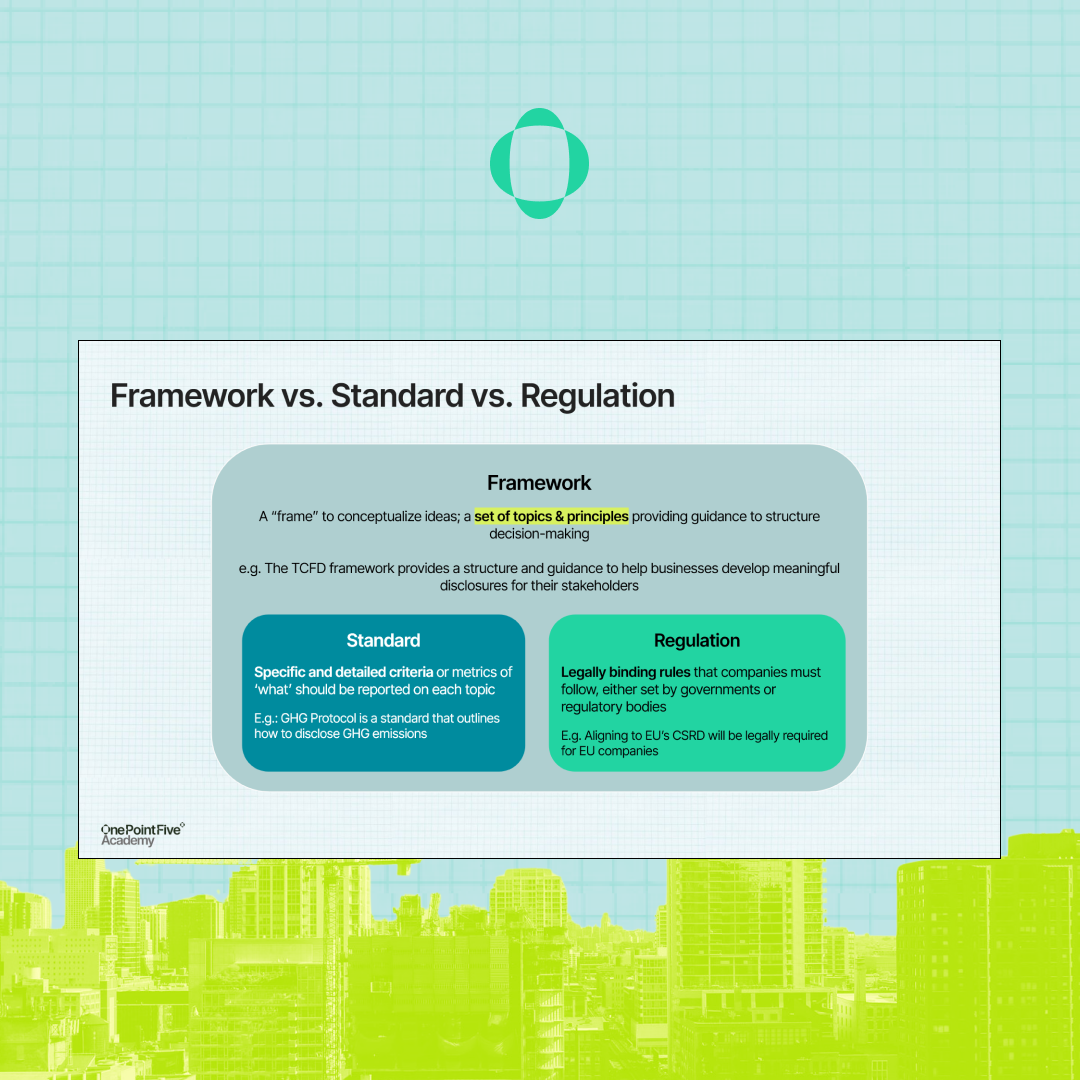
Distinguish between frameworks (TCFD, SDGs), standards (IFRS S1 & S2, GRI, SASB), and regulations (CSRD, SB-253, SECR)
Identify which disclosure requirements apply to your organization based on geography, revenue thresholds, and industry
Understand the four-step process for corporate sustainability reporting: comply with mandates, identify material issues, follow standards, and report progress
Navigate the IFRS S1 & S2 standards and understand their role in creating global baseline disclosures
Use materiality assessment tools to identify relevant sustainability topics and metrics for your industry
Differentiate between ESG reporting, sustainability reporting, and climate reporting based on scope and audience
Report Scope 1, 2, and 3 emissions alongside other environmental metrics (energy, water, waste, ecological impact)
Recognize the limitations of reporting without execution and the importance of credible transition plans
Leverage sustainability transparency as a strategic differentiator for investors, customers, and talent
Optional add-ons
2-3 hour Labs: Practice materiality assessments and report preparation using industry-specific frameworks and real disclosure examples
1-2 hour Workshops: Specific workshops focused on reporting and disclosure implementation for your organization
Module details
Duration: 2-3 hours total learning time
Materials: Video content, regulatory timelines, framework comparison guides, company disclosure examples, materiality tools, downloadable resources
Prerequisites: Module 2 (GHG Accounting) recommended to understand Scope 1, 2, and 3 emissions reporting requirements | Designed to build on organizational emissions concepts
