Climate Regulations on the Horizon, Part 2: Europe & The UK’s Next Moves
By Lucie Paumier (OPF 2026 Summer Sustainability Associate), Elaine Liu (OPF 2026 Summer Strategy Consultant), Laura Latorre (Sustainability Training & Community Coordinator), and Julia Akker (Associate Director), OPF.
You’re reading Part 2 of our “Climate Regulations on the Horizon” series. Explore the full series here
Europe has arguably gone further than any other region in advancing sustainability regulation, with the EU driving most of the effort. A large number of rules have been formally proposed and passed, but significant pushback has eased requirements, raised revenue thresholds, and cut the number of companies in scope — the CSRD and CSDDD were both substantially narrowed, and the EU Deforestation Regulation (EUDR) has now been delayed twice, to December 30, 2026. Timelines have slipped and requirements have been rewritten, yet the rules remain live, and one of them is already in force.
The Empowering Consumers for the Green Transition (ECGT) Directive took effect on September 27, 2026, and it applies to any company selling to consumers in the EU, not only those established there. For global brands, that makes it the most immediately consequential regulation covered in this blog. Below, we look at the three developments shaping the the EU and the UK in 2026: the ECGT Directive on green claims, the EUDR on supply chain traceability, and the UK's new Sustainability Reporting Standards, spanning consumer protection, supply chain transparency and broader climate accountability.
Now in Force: Closing the Greenwashing Loophole
The ECGT Directive, “EmpCo” or Directive (EU) 2024/825, was adopted in February 2024 and has applied since September 27, 2026. It targets deceptive practices that often prevent consumers from making informed purchasing decisions or building sustainable consumption patterns. These practices include early or planned obsolescence, where a company deliberately reduces a product lifespan to drive new or replacement purchases, as well as greenwashing, which encompasses misleading environmental claims. Brands can no longer use vague, unsubstantiated product labels like “eco-friendly” or “net-zero” without clear, verifiable proof.
Picture a company selling a pair of “climate neutral” sneakers. The directive stipulates that offsetting can no longer be used to evidence a neutrality claim. Now, neutrality must be tied to real reductions in the product's footprint, and traced back to product-level evidence such as a verified product footprint or a certification mark, which can be found on the product page, behind a QR code on the box, or in the company's sustainability report. Traceable evidence gives the customer confidence that the premium they are often paying for a sustainable good is actually warranted. The result is a positive feedback loop: real emissions reductions, protected consumer rights, and repeat revenue for the brands that are actually doing the sustainability work behind the scenes.
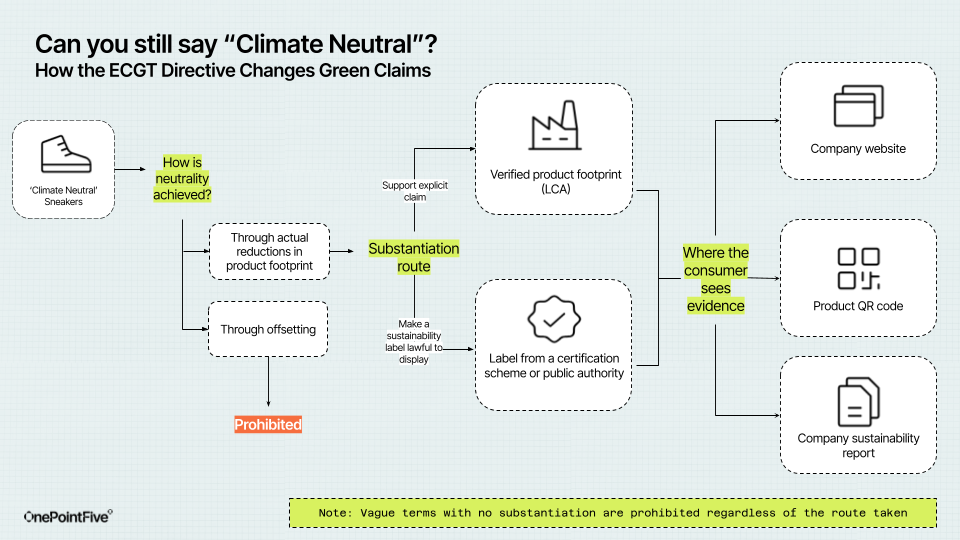
Figure 1: Example pathway of a verifiable claim of “climate neutral” sneakers under the EU’s Empowering Consumers for the Green Transition (ECGT) Directive.
The directive’s impact goes beyond just consumers and brand marketing teams. Upstream suppliers need to produce reliable information on demand and regulators and certification bodies will be tasked with verifying claims rather than taking them at face value. For example, for a pair of sneakers being labelled as climate neutral, the producer or seller needs a life cycle assessment that supports the claim, potentially structured around the ISO 14024 Type I eco-labelling scheme.
→ The trend to watch:
The EU is treating greenwashing less as an environmental issue and more as a core consumer protection violation. As such, this kind of regulation will likely be more strictly enforced than sustainability-specific rules alone.
→ The action to take:
This regulation is now live, so the time for preparation has passed. Inventory every claim you make to EU consumers, such as across packaging, product pages, ads, and retail partners’ listings. Determine which claims are evidenced per the EGCT Directive, which can be evidenced, and which are unsupportable. For any unsupportable claims, adjust messaging or pull the claims entirely to avoid potential enforcement action, and generate the required evidence in parallel.
December 2026: Tracing Supply Chains to the Source
The European Union Deforestation Regulation (EUDR), or Regulation (EU) 2023/1115, requires companies to use precise geo-location data to prove that commodities like cattle, cocoa, coffee, palm oil, soy, rubber and wood are not linked to deforestation after December 31, 2020. The regulation entered into force in June 2023, but application was pushed back in December 2025. The resulting deadlines are: large and medium operators¹, along with micro and small operators² already covered by the EU Timber Regulation, must comply by December 30, 2026. The remaining micro and small operators have until June 30, 2027.
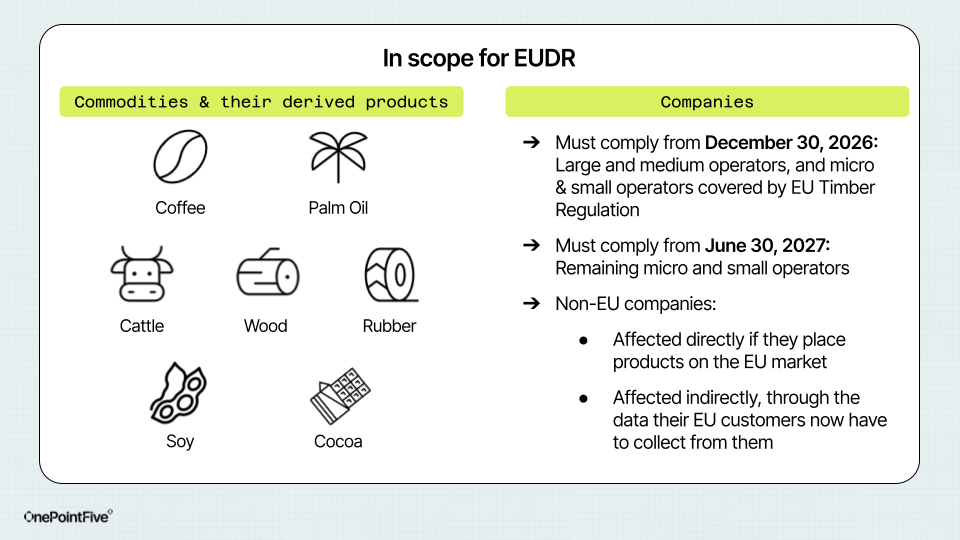
Figure 2: High-level snapshot of in-scope forest-risk commodities and companies affected by the EUDR.
The rules are designed to support a shift toward deforestation-free value chains worldwide, cutting at least 32 million tonnes of carbon emissions a year tied to EU commodity consumption and production, while reducing the EU’s contribution to global deforestation, GHG emissions, and biodiversity loss. The regulation also shifts the burden of responsibility; rather than leaving the consequences of deforestation concentrated in the producing countries of the global south, the EUDR puts the onus on the large importers and traders profiting from those supply chains.
→ The trend to watch:
Regulators are shifting environmental accountability for commodities onto the companies earning revenue from them, not just the companies growing them, with supply chain transparency being used to protect the ecosystems the commodities depend on.
→ The action to take:
If you have supply chain exposure to any commodity in scope, start building traceability infrastructure now, such as by mapping suppliers, collecting geo-location data from farms, and deploying systems to store and track the data, that way any gaps are identified well before your first impacted shipment.
Proposed: UK Reporting to Get on the Same Page
While much of Europe's 2026 agenda is focused on expanding due diligence and product regulation, the UK is taking a different route and concentrating on aligning sustainability reporting with international standards. In February 2026, the UK government published the UK Sustainability Reporting Standards (UK SRS S1 and S2), based on the ISSB's IFRS S1 and IFRS S2. Unlike the UK's earlier TCFD-aligned requirements, the UK SRS provides a broader reporting framework that is designed to be consistent with other jurisdictions adopting ISSB standards.
The standards are final and available for voluntary use; however, mandatory reporting is not yet in force. The Financial Conduct Authority (FCA) is expected to publish its final policy statement in Fall 2026, following its consultation on incorporating UK SRS into the Listing Rules, which set the requirements a company must meet to sell shares to the public in the UK. Mandatory reporting under UK SRS S2 has been proposed for accounting periods beginning on or after January 1, 2027 for in-scope listed (i.e., public) companies. The UK Government has also signaled a separate consultation on extending the requirements to the country's largest private companies.
→ The trend to watch:
Rather than developing entirely new reporting frameworks, more jurisdictions are adopting ISSB-based standards with local modifications; this pattern is also visible across APAC. This growing convergence should improve comparability for investors and reduce reporting complexity for multinational companies operating across markets.
→ The action to take:
Check whether your company meets the proposed qualification criteria, then run a gap assessment against ISSB guidance to see which new activities may be required, such as climate risk and opportunity identification, scenario analysis, and GHG accounting.
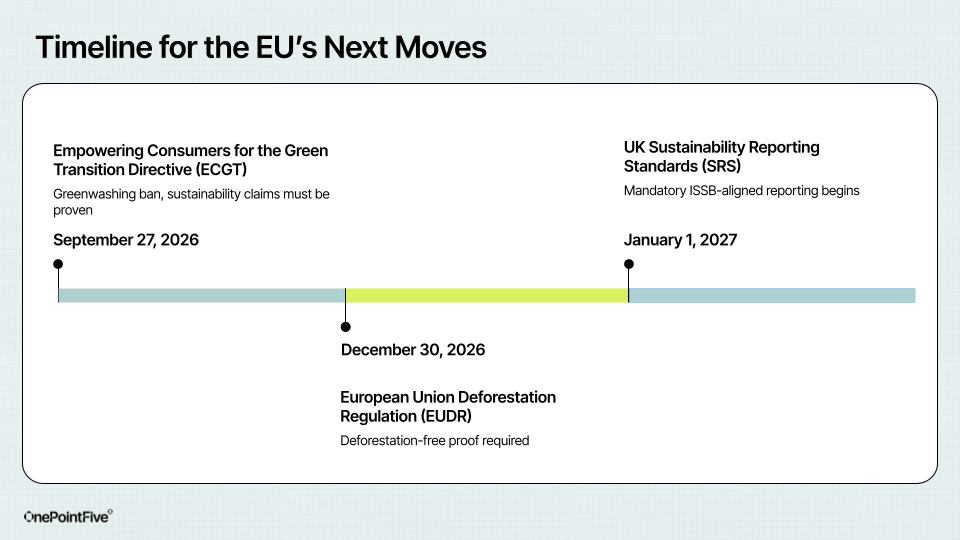
Figure 3: High-level timeline of upcoming EU/UK regulations.
What’s next for global regulation
This is the second part of our three-part series on the sustainability regulations shaping global business in 2026. Next, we'll end the series with APAC, covering the AI boom, the push toward regulatory unification, and IFRS adoption from Thailand to Australia.
Subscribe to our newsletter for the rest of the series and more updates on sustainability regulations around the world.
¹Large & medium operators: any natural or legal person who places relevant products on the EU market or exports them, excluding “downstream operators”and “micro or small primary operators”
²Micro or small operators: a natural person or micro or small enterprise, under EU accounting rules, established in a low-risk country which places on the market or exports the regulated products they themselves have grown or obtained.