By Lucie Paumier (OPF 2026 Summer Sustainability Associate), Elaine Liu (OPF 2026 Summer Strategy Consultant), Laura Latorre (Sustainability Training & Community Coordinator), and Julia Akker (Associate Director), OPF.
You’re reading Part 3 of our “Climate Regulations on the Horizon” series. Explore the full series here
Mandatory sustainability disclosure is spreading quickly in Asia-Pacific (APAC), and its regulators are moving on AI infrastructure and environmental law as well. Singapore's Digital Infrastructure Bill brings large data centers under mandatory licensing with efficiency benchmarks, one of a growing number of efforts worldwide to regulate AI infrastructure. China, a major driver of the energy transition, has brought into force a unified Ecological and Environmental Code that writes its carbon goals into law. And across the region, from Australia to Japan, more markets are making disclosures aligned with the IFRS Sustainability Disclosure Standards (IFRS S1 for general sustainability, IFRS S2 for climate) mandatory. Below, we look at these three developments shaping the region in 2026.
Passed: Regulating the AI Boom
On October 7, 2026, Singapore's Parliament passed the Digital Infrastructure Bill, which introduces mandatory licensing for data centers with at least 3 MW of critical IT load¹. Licensed operators will need to meet minimum energy-efficiency benchmarks, with water-efficiency requirements to follow where necessary.
Regulators can also factor an operator's use of renewable energy, and the emissions from its electricity supply, into licensing decisions. Enforcement details are still being worked out and will be set out in subsidiary legislation and codes of practice. Elsewhere in the region, Thailand has paused approvals for new data center projects while it develops national standards.
→ The trend to watch:
Regulators are scrutinizing how sustainably data centers source and use their energy, in addition to how much they consume.
→ The action to take:
Ask your data center and cloud providers now for their energy-efficiency (PUE), renewable sourcing, and electricity-emissions data. Singapore's bill is likely an early signal of where data center regulation is headed as AI-driven energy demand climbs, and these are the figures licensing regimes are starting to ask for.
Now in Force: Bringing Environmental Law Under One Roof
China's Ecological and Environmental Code, adopted on March 12, 2026, recently took effect on August 15, 2026. It is China's second formal legal code, after the 2020 Civil Code. It folds 10 environmental laws into a single, unified framework, while most other environmental laws continue alongside it.
At its core, the code writes low-carbon development and carbon peaking into law by embedding China's "dual carbon" goals directly into the legal system (peaking carbon emissions before 2030 and reaching carbon neutrality before 2060). It rests on six guiding principles: prevention, systems-based governance, ecology-first decision-making, green development, public participation, and liability for harm.
The code's reach is broad. It applies to ecological and environmental protection activities across China's territory and assigns responsibilities to local governments, to enterprises and other businesses, and to citizens, and encourages social organizations to take part.
→ The trend to watch:
China is moving away from a fragmented, sector-by-sector approach to environmental regulation, and instead toward a single consolidated, carbon-focused legal framework. This shift is one that other jurisdictions may model as well.
→ The action to take:
Companies with operations or supply chain exposure in China should start mapping their current compliance obligations against the new code; a single consolidated framework may lead to more targeted scrutiny than before.
Phasing In: The Disclosure Wave Keeps Building
APAC is moving fast to adopt the IFRS Sustainability Disclosure Standards. Many markets are adopting the standards as a baseline and adapting them to local context rather than building frameworks from scratch, and many are making them mandatory. Japan, Singapore, Australia, Malaysia, Hong Kong, Taiwan, and the Philippines already require reporting for current fiscal years from at least their largest companies. South Korea and Thailand have both set fiscal year 2027 as their first mandatory year.
While our focus here is on the region's major capital markets, Sri Lanka and Pakistan have also mandated IFRS-aligned reporting, and New Zealand requires climate reporting under its own standards. China is on a separate track: its stock exchanges have required sustainability reports from more than 450 large listed companies since FY2025, under guidelines the IFRS Foundation lists separately, while the Ministry of Finance's IFRS-based standards remain voluntary for now.
In Singapore, IFRS-aligned climate reporting has been mandatory for STI²-listed companies since FY2025, and all listed companies report Scope 1 and 2 emissions. The Accounting and Corporate Regulatory Authority (ACRA) is now finalizing national standards on top of that baseline: the draft Singapore Sustainability Disclosure Standards, under which only the climate standard is proposed as mandatory. The public consultation runs through October 25, 2026, and all listed companies are expected to be covered by FY2030.
Japan has also made Sustainability Standards Board of Japan (SSBJ) disclosures mandatory, for its largest Tokyo Stock Exchange (TSE) Prime Market companies. Reporting starts with fiscal years ending March 2027 for roughly 70 companies with a market cap of ¥3 trillion or more. Companies above ¥1 trillion follow a year later, and the government's roadmap plans a further step to ¥500 billion for fiscal years ending March 2029.
Elsewhere, timelines differ by market.
APAC IFRS-Aligned Disclosure Timelines
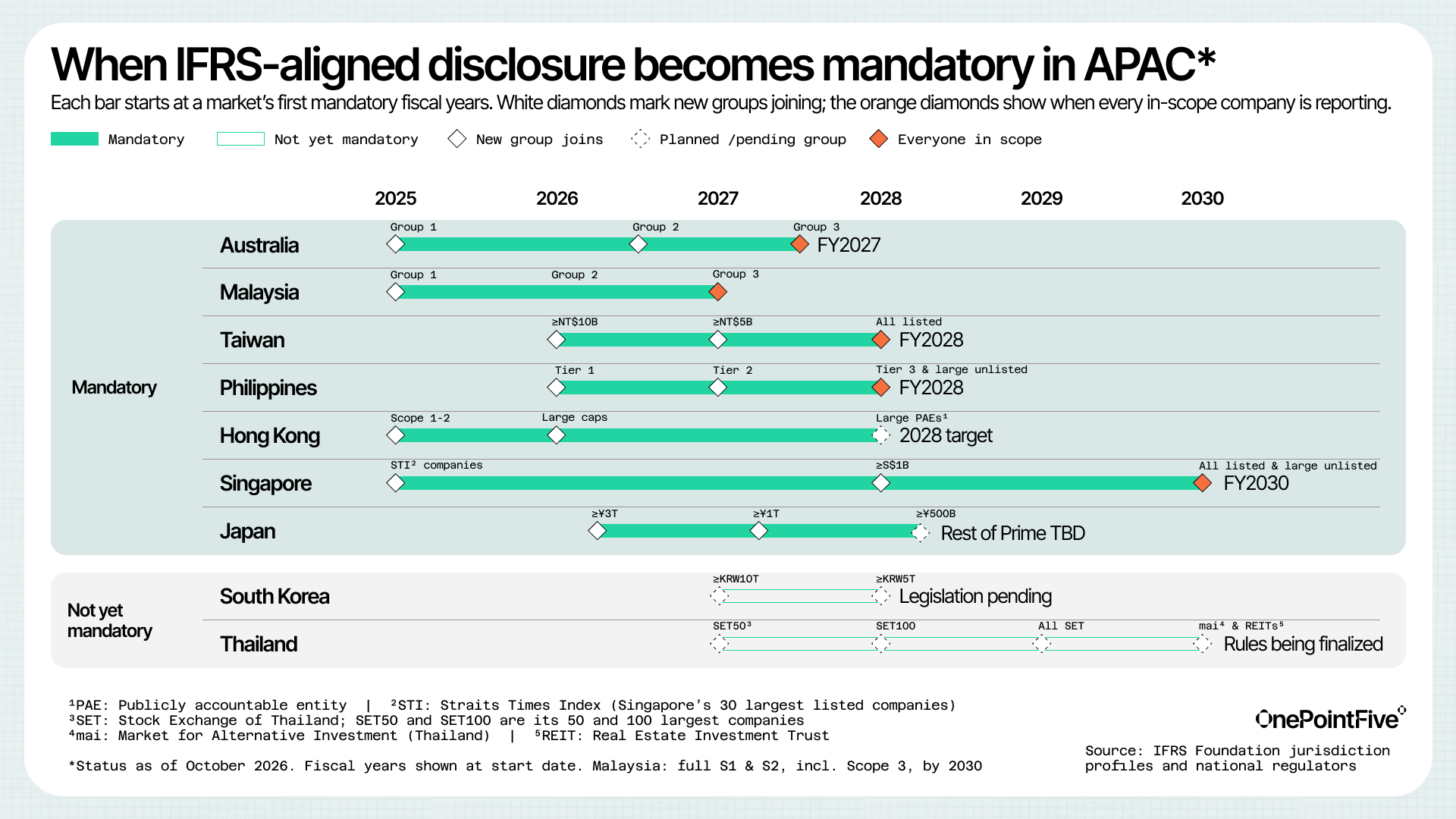
Figure 1: Timeline of IFRS-aligned sustainability disclosure requirements across APAC markets. View and download the high-quality version here.
Australia and Malaysia have required reporting from their largest companies since FY2025, and both bring every in-scope company in by FY2027, though Malaysia gives its last group until 2030 for full compliance, including Scope 3. Taiwan reaches all listed companies by FY2028, as does the Philippines, which also brings in large non-listed companies that year under its Philippine Financial Reporting Standards (PFRS S1 and S2).
Hong Kong requires Scope 1 and 2 emissions from all listed companies and full climate disclosures from large caps, and targets full adoption for large publicly accountable entities by 2028. South Korea has finalized its roadmap, but its enabling legislation is still pending, and Thailand is still finalizing its implementing rules.
→ The trend to watch:
Climate is being prioritized compared to general sustainability disclosures: Australia, Singapore, and Hong Kong mandate only the climate standard, Thailand will allow climate-only reporting for its first five years, and the Philippines allows it for the first 1-2 years. Every country is planning or in the midst of a multi-year, staggered rollout, with the most advanced markets reaching full reporting coverage in 2027.
→ The action to take:
Sustainability teams should map which of their APAC entities fall under which market's timeline now, so climate reporting infrastructure is ready well ahead of each mandatory reporting year.
Swipe the table sideways to see all columns →
| Market | Standards | Reporting now | Full Rollout | Full coverage | Reaches non-listed? |
|---|---|---|---|---|---|
| Australia | AASB S2 mandatory (S1 voluntary) | Group 1, FY from Jan 2025 | Group 2 FY Jul 2026; Group 3 FY Jul 2027 | FY from Jul 2027 (reports 2028) | Yes |
| Taiwan | IFRS S1+S2 (both mandatory) | ≥NT$10B capital, FY2026 | ≥NT$5B FY2027; all listed FY2028 (climate-only to 2030) | FY2028 | No |
| Hong Kong | HKEX IFRS-aligned climate rules (S2 mandatory) | Scope 1&2 all issuers; Large cap full climate since Jan 2026 | Pending HKEX consultation 2027 | 2028 target | No |
| Japan | SSBJ (S1+S2 basis, both mandatory) | ≥¥3T, FY ending March 2027 | ≥¥1T FY ending March 2028; ≥¥500B FY ending March 2029 | FY ending March 2029 | No |
| Malaysia | IFRS S1+S2 (both mandatory) | Main Market issuers with market cap ≥RM2bn (FY2025) | Group 2 (other Main Market issuers) from FY2026; Group 3 (ACE Market issuers and large non-listed companies with revenue ≥RM2bn) from FY2027; full compliance (incl. Scope 3) by group: Group 1 by 2027, Group 2 by 2028, Group 3 by 2030 | 2030 (all entities in by FY2027; 2030 is full Scope 3) | Yes (≥RM2B rev, FY2027) |
| Singapore | SFRS S2 mandatory, S1 voluntary | All listed Scope 1&2; STI full disclosures (Scope 3 FY2026) | Non-STI companies (>S$1B) join FY2028; smaller listed companies join FY2030 | FY2030 | Yes (≥S$1B rev, FY2030) |
| Philippines | PFRS S1+S2 (both mandatory) | First tier of listed companies (by market cap), FY2026 | Remaining listed tiers phased in by market cap; large non-listed entities qualify on FY2027 revenue | TBC (confirm tier dates) | Yes (large non-listed) |
| South Korea | KSDS 1&2 (S1 and S2 mandatory) | None; roadmap final Jul 2026, legislation pending | ≥KRW10T assets FY2027 (reports 2028); ≥KRW5T FY2028 | Open; KRW2T considered from 2030 | No |
The Big Picture
Across all three regions, sustainability regulation is spreading in different forms. North America is acting through targeted, often state-led rules on energy and PFAS; the EU is holding companies accountable for their green claims and supply chains; the UK is moving to IFRS-aligned reporting; and Asia-Pacific is moving fast on mandatory disclosure.
For sustainability teams, the priority is tracking which requirements apply, where, and when. In APAC, that means planning for staggered, market-by-market deadlines that typically start with climate disclosures.
Explore the regulatory changes covered in Parts 1 and 2:
Subscribe to our newsletter for more updates on sustainability regulations around the world.
¹Critical IT load is the power capacity dedicated to a data center's computing hardware (servers, storage, networking), excluding cooling, backup systems, and other facility overhead. All operators at 3 MW or more will need a license, and major colocation and cloud data centers at 10 MW or more also need a separate security and resilience license.
²STI: the Straits Times Index, which tracks the 30 largest companies listed on the Singapore Exchange (SGX).