Cutting Through the Green Noise: Financing the Fashion Supply Chain Transition
By Vanesa Vargas (Marketing Coordinator) and Ysabella Langdon (Marketing Manager), OPF.
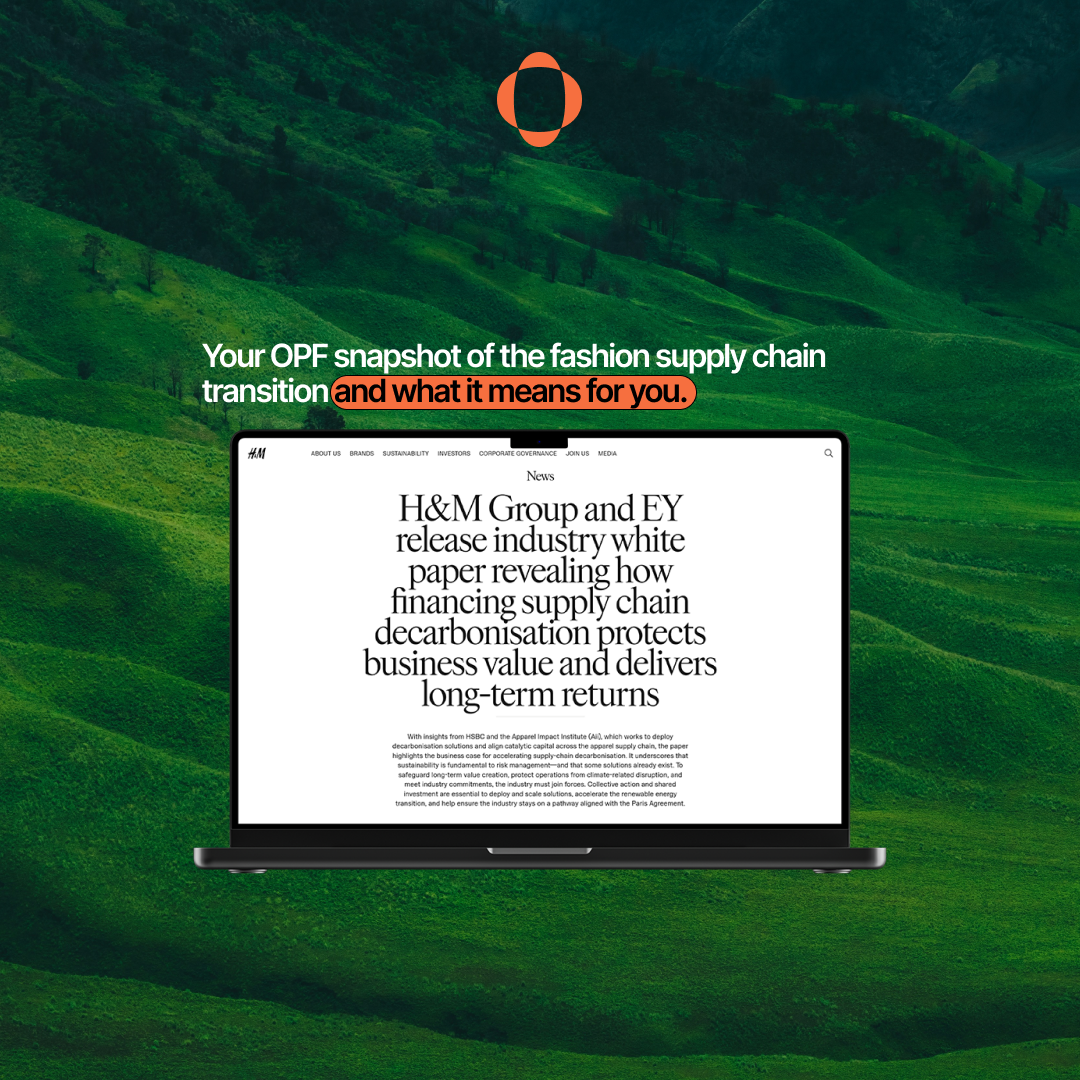
On March 11, H&M Group, EY, supported with insights by HSBC and the Apparel Impact Institute (Aii), have released a whitepaper focused on a roadmap for fashion’s most systemic challenge: paying for decarbonization. While the sector accounts for a significant portion of global emissions, the vast majority of that impact happens in factories and mills that brands do not own. This paper highlights a massive bottleneck: traditional financial models favor short-term profits, leaving suppliers unable to afford the green technology needed to hit 2030 targets. To bridge this gap, the industry must move beyond individual "pilot projects" and embrace collaborative, shared-risk financing that treats supply chain resilience as a core business asset.
The Data Snapshot
95%: The proportion of a leading fashion brand's carbon footprint typically hidden within Scope 3 emissions.
$1.04 trillion: The total investment required to transition the global apparel industry to net-zero by 2050.
15 years: The payback period for deep decarbonization upgrades, which is often too long for traditional bank loans to cover.
40%: The potential emissions reduction achievable through existing technical solutions if the financing gap is closed.
🧑🏫 The Reality
Decarbonization is a shared infrastructure cost, not a private supplier burden.
The bottleneck is not a lack of technology; it is a lack of accessible capital. Strategy must shift from: Individual brand demands to collaborative, blended-finance platforms. When brands pool their credit strength and resources, they lower the cost of capital for factories, making green upgrades a viable business decision for everyone in the chain.
🔔 The Alarm
"Fashion’s climate goals are stalling because suppliers are refusing to change."
There is a growing fear that the industry will miss its 2030 targets because factory owners are hesitant to take on debt. This panic often blames a lack of supplier "willpower" rather than addressing the fact that the financial burden currently rests entirely on those with the thinnest margins.
Your Action Plan
For job seekers
Bridge the finance-sustainability gap: Rather than just metrics and environmental knowledge, position yourself as a professional who understands and can act on blended finance and supply chain risk.
Target the middle of the chain: Look for roles within Tier 2 and Tier 3 suppliers or manufacturing hubs, where the actual implementation of carbon reduction happens.
For active professionals
Reframe carbon as a financial risk: Work with your CFO to show how inaction in the supply chain creates long-term price volatility and regulatory exposure.
Partner with procurement: Ensure that sustainability goals are considered and prioritized in long-term purchasing contracts to give suppliers the security they need to invest in green tech.
For businesses & leaders
Invest in shared financing vehicles: Stop running isolated pilots and join industry-wide initiatives, like the Future Supplier Initiative, to pool risk and capital.
Provide credit guarantees: Use your corporate balance sheet to help your suppliers access lower-interest loans for high-impact equipment like electric boilers or solar arrays.
The Bottom Line
Solving fashion’s carbon crisis is no longer a materials or design challenge: it is a financial one that requires brands to co-invest in their suppliers’ future.
Enjoyed this edition? Click here to explore the rest of our Cutting Through the Green Noise series for concise breakdowns of the sustainability reports, research and trends shaping climate and business.
Equip your team to bridge the fashion financing gap
Financing the transition is only half the battle; you need a workforce that can actually execute. As Frank Zambrelli (Accenture) highlights in our playbook, “Forget the Sustainability Unicorn: How to Upskill a Climate Workforce”, fashion doesn’t need a single "Sustainability Unicorn": it needs an army of sourcing and merchandising professionals who understand how to pull climate levers.
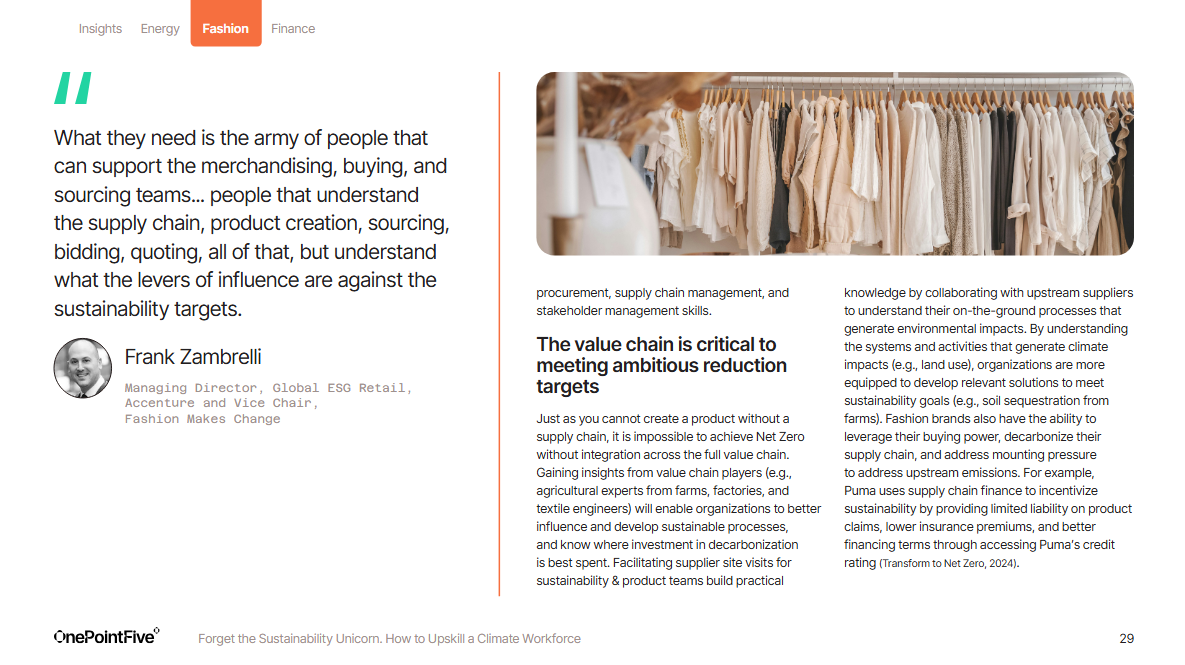
Forget the Sustainability Unicorn: How to Upskill a Climate Workforce.
In our free playbook, where we talk about Energy, Fashion and Finance, we draw on insights from 30+ industry experts and 3,500+ climate professionals to show you how to move beyond unrealistic hiring and build the functional climate literacy your value chain actually requires.