By Vanesa Vargas (Marketing Coordinator) and Ysabella Langdon (Marketing Manager), OPF.
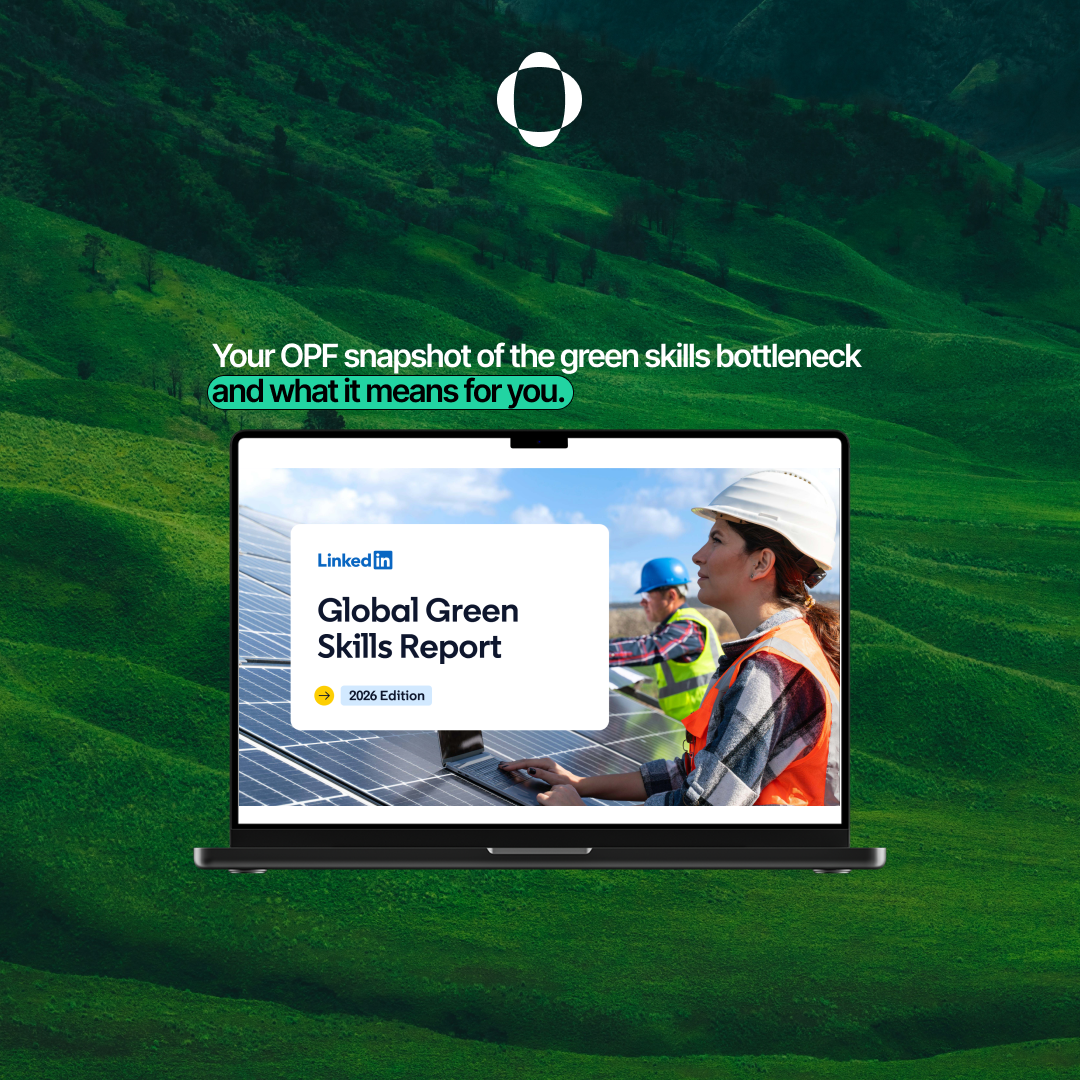
Green skills are spreading well beyond sustainability teams, into finance, operations, technology and the skilled trades, as companies look for ways to build efficiency, manage risk and stay competitive. LinkedIn's latest Global Green Skills Report 2026 tracks how quickly that shift is happening, and whether the workforce is keeping up.
What LinkedIn found is that employer demand for green talent continues to grow faster than workforce supply, turning skills into a bottleneck for climate action and economic growth; and, because most green hires now go into roles without a green job title, the fastest way to close the gap is to build green skills into the roles and teams organizations already have.
The Data Snapshot
65% more green hiring than green talent across industries: In every industry LinkedIn examined, the median share of green hiring was 65% higher than the median concentration of green talent in the workforce. Since 2021, green hiring has grown at 13.1% a year, against 11.0% for green talent.
3 in 4 green hires land in roles without a green title: 73.9% of green hires went into roles without a traditional green job title, as employers look for people who can apply green skills alongside expertise in finance, technology, procurement, operations and manufacturing.
52.7% higher hiring rate for green talent: As of July 2026, green talent was hired at a higher rate than the overall workforce. That advantage has grown since 2021 in virtually every country examined, including France and Germany, where green talent had little or no hiring advantage five years ago.
Green skills among data center talent have tripled since 2021: The median share of data center talent with at least one green skill rose from 3.9% to 13.8% between 2021 and 2026, while the International Energy Agency reports that data center electricity consumption increased 17% in 2025 and is projected to double by 2030.
🧑🏫 The Reality
Green skills are becoming core business skills.
The shift is from "green jobs" as a niche set of titles → to green skills built into every function. Among green talent, nearly two-thirds now hold green skills without a green job title, and that shift is accelerating: the share grew by a median of 2.4 percentage points a year from 2016 to 2023, and by roughly 4.1 points a year since 2024.
Efficiency is where this is most visible. Skills in LinkedIn's Waste Prevention category make up one in four green skills held globally, and Operational Efficiency is among the fastest-growing green skills in 21 of the countries examined, a sign that cost pressure and climate goals are increasingly pointing in the same direction.
🔔 The Alarm
"Sustainability is in retreat, so green skills are a career dead end."
With fewer Chief Sustainability Officer roles and shifting climate language from businesses, it's easy to read the market as pulling back. The Weinreb Group's 2026 Chief Sustainability Officer Report found that the number of CSOs at U.S. publicly listed companies declined 10% in 2026; yet 42% of CSOs reported increased sustainability headcount outside their core function, compared with 28% reporting growth within it. As the report concludes, the work is dispersing throughout companies rather than disappearing, and LinkedIn's hiring data points the same way.
Your Action Plan
For job seekers
Make your green skills visible: Most green hires now land in roles without a green job title, so list your green skills on your profile and tie each one to a result you delivered.
Layer green skills onto your current career: LinkedIn's data suggests the fastest route to green opportunity may run through the career you already have. Add one green capability that fits your function, such as operational efficiency or carbon accounting, to the expertise you've built.
Map your transferable skills: Green roles often reuse skills you already have. As an example, LinkedIn’s UK Green Skills Report 2026 points to a roughly 60% skills overlap between offshore oil and gas and offshore wind, which makes it one of the most direct routes into the renewables sector.
For active professionals
Lead on efficiency: Use efficiency, waste reduction and process optimization to deliver cost savings and climate progress in your own function, in terms both finance and sustainability teams already care about.
Pair green skills with AI: The median share of green talent with AI skills reached 4.2% in 2026, up from 0.5% in 2021. Explore how sustainable AI can speed up data collection, analysis and reporting in your role.
For businesses & leaders
Build before you buy: 62% of people surveyed by LinkedIn said they would take part in more sustainability-related activities at work if offered, but only 15% said their employer currently provides training. Closing that gap is one of the most direct ways to grow green capability in-house.
Hire for skills, not titles: Reconsider degree and experience requirements and recognize transferable skills; LinkedIn data show skills-based hiring increases green talent pools by 3.5x globally. It also widens access for women, who still make up just 30.1% of green talent.
The Bottom Line
Green skills have moved from a specialist niche into the core of how businesses operate, and the organizations that build them inside the teams they already have will be best placed to deliver on both their climate and growth goals.
Explore LinkedIn's full industry, country and generational breakdowns, plus its six policy recommendations, in the complete 2026 report.
Enjoyed this edition? Click here to explore the rest of our Cutting Through the Green Noise series for concise breakdowns of the sustainability reports, research and trends shaping climate and business.
Want to see how 2026 compares to previous years? Click here to revisit our edition covering LinkedIn's 2025 Green Skills Report.
Still searching for a sustainability unicorn?
Building green skills can start with the talent you already have In our free playbook, “Forget the Sustainability Unicorn: How to Upskill a Climate Workforce,” we draw on insights from 30+ industry experts and 3,500+ climate professionals to show how organizations can build green skills inside the teams they already have.