By Laura Latorre (Training & Community Coordinator), Narandelger Erdenebileg (Sustainability Associate), Susannah Hill (Co-Founder of Cloud Sustainability Watch), Matthias Muehlbauer (Co-Founder & COO), and Neil Yeoh (CEO & Founder).
Why we measure
Last month, we shared OnePointFive’s 2024 Scope 1, 2, and 3 carbon emissions following the Greenhouse Gas (GHG) Protocol's conventional calculation approaches — what we call our "GHG inventory”. This is a deeper dive into our digital carbon emissions as a Part 2 of emissions measurement journey. As leaders in GHG accounting education who also help clients measure and reduce their digital carbon footprints, we believe in walking the talk. With our online activities growing rapidly, we need to understand and demonstrate the same impact we help others address. For the project we called on Susannah Hill to provide expertise; Susannah is a digital sustainability consultant and co-founder of Cloud Sustainability Watch, as well as a proud OPFA alum.
In traditional GHG Protocol, sources of digital emissions are scattered throughout Scopes 1-3: office electricity (Scope 2), software subscriptions (Scope 3, Purchased Goods & Services), website visitors (Scope 3, Use of Sold Products); amongst others. This scattering obscures the full picture and, as a result, organizations often underestimate their environmental impact unless they use granular, digital-specific data and methods.
“With a growing footprint from cloud emissions, data centers, and AI, it is important for our team to start understanding our digital emissions footprint, and build a baseline. This will be key in future years as we grow, and digital and AI services integrate more and more into workflows.” — Matthias Muehlbauer, Co-Founder & COO.
Executive Summary
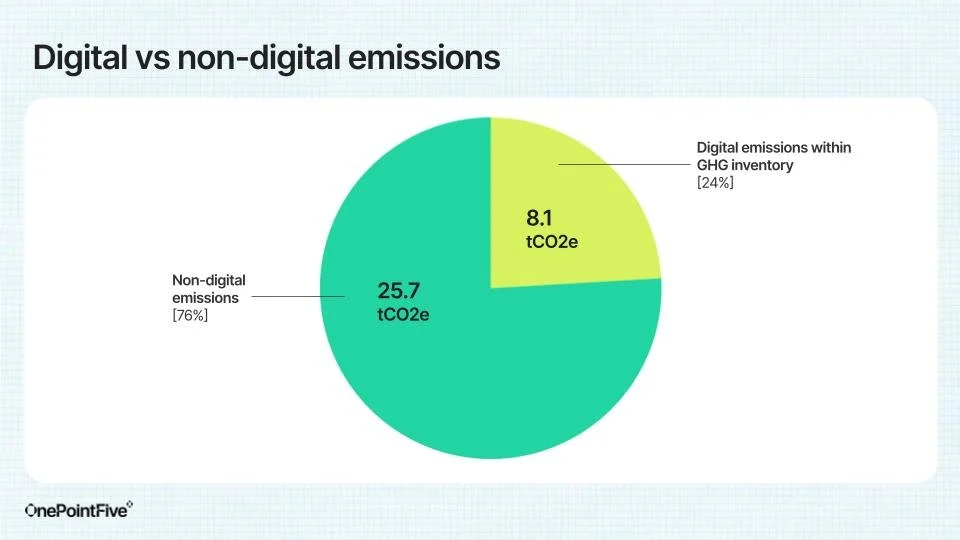
In 2024, OPF’s digital activities generated 8.1 tCO₂e, which is approximately 24% of our total organizational emissions. This is equivalent to driving 20,700 miles with an average gasoline powered passenger vehicle.
Traditional spend-based GHG accounting captured only 7.0 of the 8.1 tCO₂e. By incorporating digital carbon emissions methodology with activity-based data, we uncovered an additional 1.1 tCO₂e, previously “invisible” emissions from website traffic, data transmission, and cloud storage.
Activity-based measurement reveals real emissions drivers. By tracking our software use, website visits, data transfer, storage, and device use, OPF identified cloud software and tools (69%) as the dominant digital emissions hotspot, followed by OPF Academy learners’ digital activity (10%).
Spend-based methods significantly underestimate impact. For example, website emissions showed that activity-based measurement identified nearly three times more emissions than spend-based accounting (0.42 vs. 0.14 tCO₂e). While the absolute footprint remains small, this result indicates the importance of activity over spend-based emissions modeling for digital emissions. (Note: Website emissions were one of the few categories where a direct comparison between activity- and spend-based calculation methods was possible.)
Most cloud application and software providers do not disclose location-specific energy use, server utilization, or carbon intensity, which is a key barrier of decarbonizing organizations’ digital value chain. Without activity-based digital emissions measurement, organizations will always underestimate their footprint and miss critical reduction opportunities, particularly as cloud usage and AI use scale rapidly.
What are digital emissions?
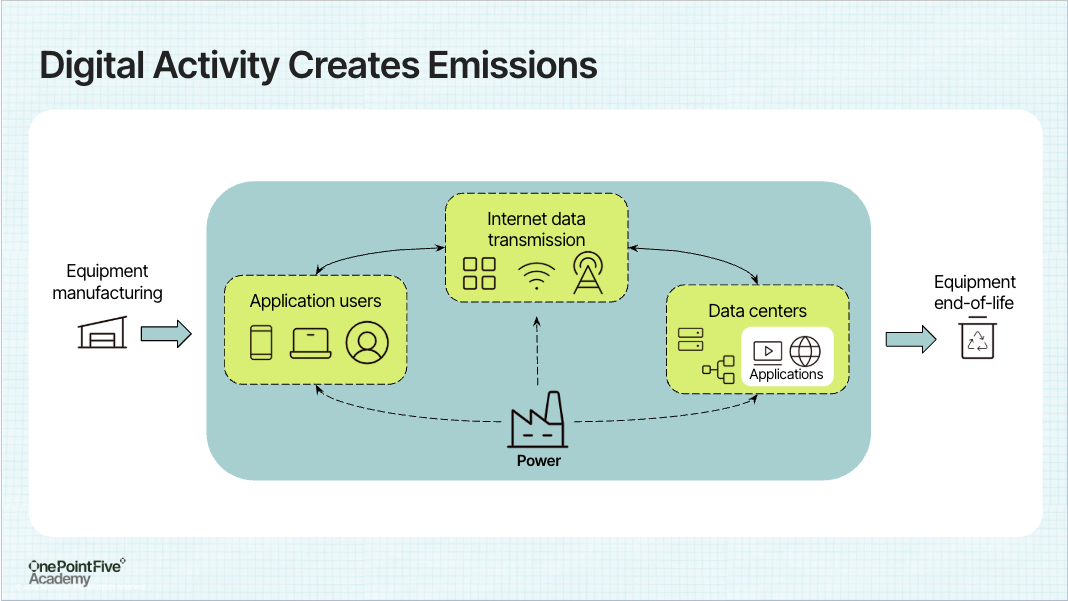
Digital carbon emissions result from energy use across the lifecycle of digital technologies and services. This includes emissions from the extraction of raw materials; manufacturing and transportation of IT equipment; the electricity necessary to power devices and data transmission networks; and energy required to operate data centers that store and process information.
Courtesy of Susannah Hill
Organizations such as the International Standards Organization (ISO), the Green Software Foundation, and the Worldwide Web Consortium offer digital sustainability frameworks to assess and address the impacts of digital infrastructure. But digital emissions measurement is still developing, and much of the data required for calculations is not disclosed by suppliers.
Why digital emissions get overlooked:
The emissions involved in the simple act of going online often remain hidden. These emissions come from various sources: the electricity used to power the IT equipment, the embodied emissions in the manufacturing of that equipment, the internet data transmission infrastructure, and the data centers that host our applications and data. All of these carbon sources are part of an organization’s digital ecosystem, and therefore should be part of the GHG inventory.
Digital emissions can seem less tangible than other emissions. A flight or a meal produces emissions you can visualize. However, clicking "send" on an email or streaming a video may not feel like it consumes resources, even though it does.
We don’t often recognize the full picture when it comes to website emissions. When someone visits a website, their device and network usage consume electricity and fall into the website owner’s scope 3 emissions. Inefficient websites with unnecessarily large files drive emissions across thousands or millions of visitors.
Cloud application customers like OPF are constrained when it comes to measuring emissions because vendors don’t currently share usage details or inputs needed for calculations. As AI multiplies the carbon intensity of online activity, this limitation means it will become harder to accurately calculate our digital footprint. With the rise of sustainability concerns around AI, some AI leaders such as Google, OpenAI, Meta, and Mistral are starting to lift the curtain on energy consumption and emissions from AI (multi-vendor study, Mistral LCA). Despite these early findings, demanding more transparency from technology companies will become more crucial than ever to meet Net Zero ambitions in the AI era.
OPF’s 2024 digital emissions
The first step to address the impacts of digital activities is to track emissions. However, we acknowledge there are other environmental and community impacts that have not been included in this initial analysis (e.g. water usage).
We piloted a digital emissions calculation learning project. Our approach combined spend-based data for software application usage and an activity-based calculation to capture end-to-end digital carbon emissions more accurately. This hybrid approach was necessary due to the lack of activity-based data for much of our software application usage.
Methodology: OPF’s digital emissions mapping
OPF calculated our digital emissions in five categories outlined below.
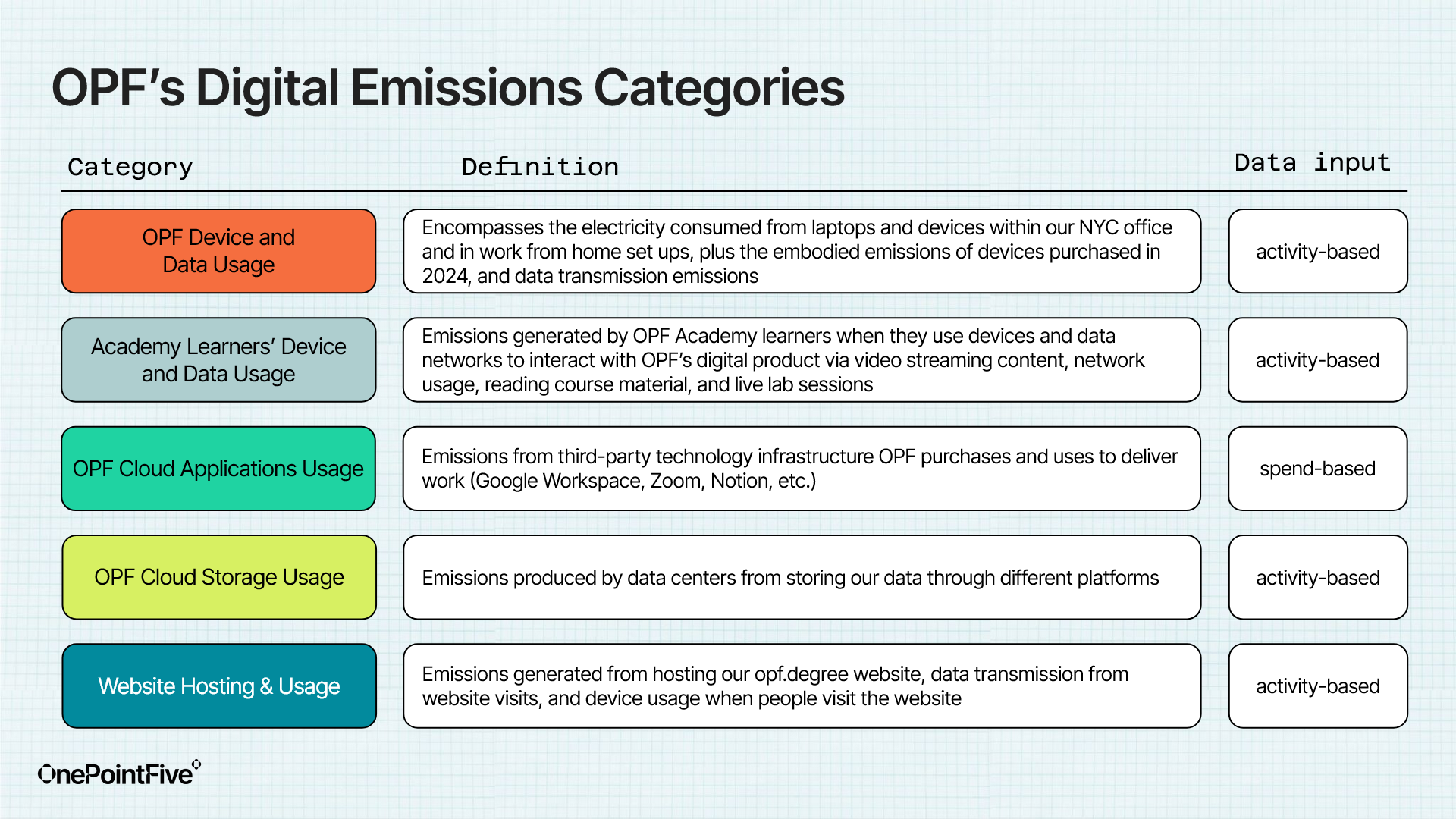
Image by OPF & Susannah Hill
We gathered OPF data to model our online activity and researched emissions factors from multiple sources to ensure accuracy, as traditional resources do not yet publish them.
Our data sources included:
Platform analytics (website visits, usage logs, video views, file storage, etc.)
Employee surveys (device types, work hours, work location, etc.)
Financial records to track subscriptions and expenditures
Emission factors (e.g. EPA, IEA, Sustainable Web Design Model, etc.)
Findings: OPF’s digital footprint
Our hybrid approach revealed that our total digital emissions for 2024 were 8.1 tCO₂e, representing 24% of our total organizational footprint. The biggest hotspots were Cloud Software & Tools (69% of digital emissions) and the OPF Academy across 370+ learners (10% of digital emissions).
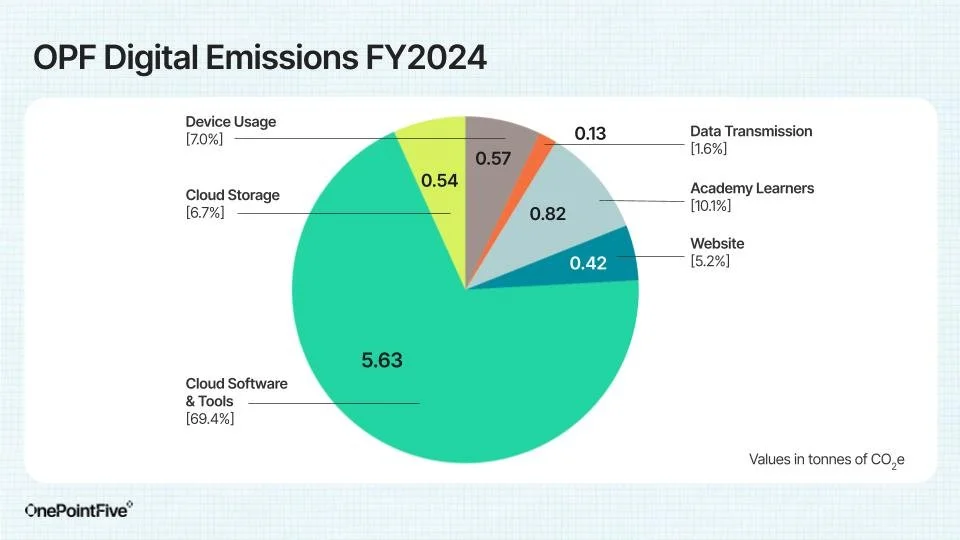
Of the 8.1 tCO₂e total, 7.0 tCO₂e was already accounted for in our GHG inventory, and 1.1 tCO2e was not included:
OPF and Academy Learners’ device usage emissions were included in the inventory, but we lacked data transmission figures.
Cloud application emissions were accounted for using the subscription fee data as part of our Scope 3 Purchased Goods Services, but the emissions factors only account for the application usage, omitting the footprint of any data storage (if an application is not primarily storage).
Emissions from website traffic and data transmission were not accounted for in our GHG inventory.
After recalculating our total 2024 emissions to include the previously invisible 1.1 tCO₂e, our revised total footprint is 33.8 tCO₂e, which is the equivalent to 7.7 gasoline powered passenger vehicles driven for a year.
Activity-based vs Spend-based: Website emissions case study
Our OPF website offered an excellent opportunity to practice digital carbon emissions measurement in this pilot. We easily gathered our website's analytics data and high-quality website emissions factors, and our analysis captured 200% more emissions than when we applied the traditional method.
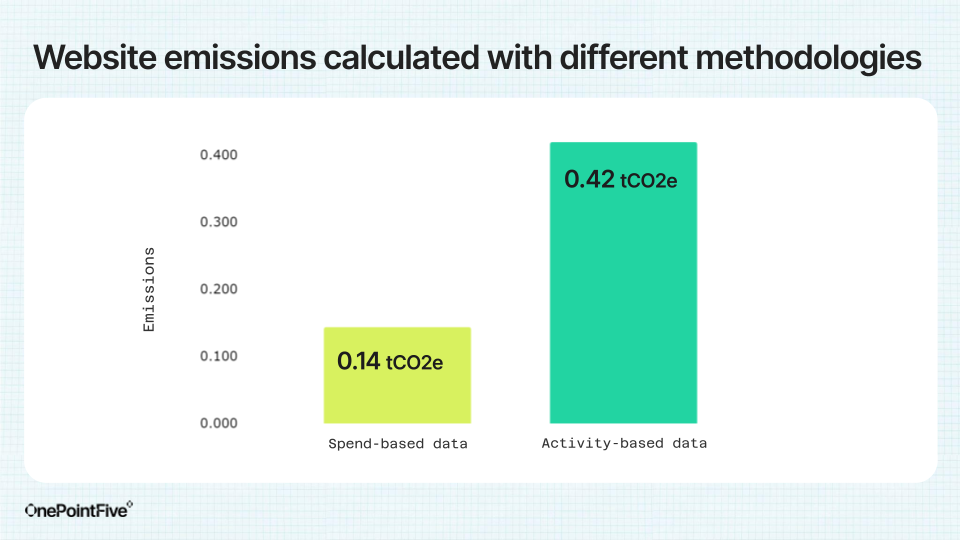
The traditional method uses spend-based data from our website hosting provider membership fees and applied industry emission factors for “website hosting services”, which resulted in 0.14 tCO₂e. On the other hand, our activity-based approach captured emissions that come from our website, including our website hosting, website data transmission, and the device usage emissions of our website visitors. This approach resulted in 0.42 tCO₂e.
Although the absolute difference in size of website carbon footprint is still small (0.28 tCO₂e is 0.8% of OPF’s total footprint in 2024), this pilot project uncovered previously overlooked carbon sources that the spend-based method missed.
Insights & Recommendations
Based on our findings, we've identified three critical areas where organizations can take action:
1) Cloud applications and storage are emissions multipliers
At 69% of digital emissions, cloud applications and tools dominate our footprint. Yet this is the only category where were not able to use activity-based measurement as software vendors do not currently disclose detailed data about our usage that enable calculation of emissions.
Organizations migrating to the cloud lose visibility into how much they continue to emit because cloud application providers don’t supply accurate data.
What can be done:
Regularly audit software subscriptions to eliminate unused software tools
Evaluate vendors on sustainability criteria:
Prioritize: Companies with trustworthy records on environmental and climate impact.
At minimum: Companies that disclose carbon emissions and how they are reducing environmental impact.
Discontinue: Companies that don’t share a sustainability policy, report carbon emissions, or include a sustainability or ESG page on their website.
Use apps designed to automate file clean-up for cloud and device storage
Compress all video, image, and documents before sharing or storing
Send and share links to stored files - don’t attach files to messages
2) Demonstrate digital sustainability principles through website
Overall, climate organizations are not yet practicing sustainable web design, as demonstrated in a recent study of 507 websites by Climate Action Tech (You Champion Sustainability. But Is Your Website Green?).
What can be done:
Design simple, clear navigation that gets visitors to their destination in fewer clicks; sustainable websites prioritize user intent rather than generating wasteful page views.
Compress media files and eliminate auto-play videos. Both reduce data transmission, which lowers emissions and improves website performance.
Use dark colors as backgrounds for slides and web pages (devices consume less electricity displaying dark pixels than bright white).
Select hosting providers with transparent environmental impact reporting as well as verifiable power efficiency and low carbon energy usage.
We plan to assess which sustainable web design practices are most effective for our site, using the “Web Sustainability Guidelines” from the Worldwide Web Consortium (and tapping Susannah’s expertise as one of the guideline’s authors). Encouragingly, we found that opf.degree already conforms to several sustainability characteristics.
3) Create an AI policy and carefully consider AI providers
In 2024, our identified AI usage was minimal. Yet AI features are increasingly appearing in almost every platform, often invisible to users: smart compose in email, automated transcription in meeting software, content suggestions in collaboration tools. Each AI interaction consumes 10-100x more energy than traditional computing. As these features proliferate, our digital emissions are multiplying without any conscious decision to adopt AI.
What can be done:
Build AI use policies to make company-wide sustainable selections for AI applications and features that are approved for use.
OPF has already begun work on AI use policy for the organization. It covers ethics, communities, and other considerations in addition to sustainability, for which it lays out how sustainability will be integrated into the development and use of AI applications.
Avoid using use extraordinarily carbon-intensive AI such as video and image generation without clear business justification. Source alternatives from standard technology or human creators.
Stay up to date with coalitions that are pushing for sustainable AI progress, such as Current AI and Hugging Face’s AI Energy Score.
If using ChatGPT or Claude chatbots, use AI Wattch to build awareness of approximate usage emissions. AIWattch is a Chrome extension that calculates energy consumption and carbon footprint of LLM prompts. Developed by IT Climate Ed (including OPF community member Pascal Joly) and Antarctica.
Be wary of quiet AI upgrades to familiar cloud applications that can create problems of hidden AI features multiplying your emissions suddenly.
Pay attention to the rapid improvements in the efficiency of generative AI by tracking how well your selected chatbots and AI-enabled applications are doing compared with other options. Seek out applications that allow you to choose smaller or optimized models and always check for greener hosting where possible. Some chatbots have downloadable “front end” apps that reduce emissions, and for the technical among you, there are mini models designed to run on your phone or laptop.
Two principles to apply when adopting AI products and features:
1. Only use AI when it is the best tool for the job. In cases where lower-impact technologies can perform a task well, make them the default.
2. Where AI is the best tool, use the lowest-impact AI option. For example, use smaller specialized AI apps designed for a given task rather than using the mammoth general purpose chatbots such as ChatGPT. Results will be more accurate and less environmentally harmful because the data and model are optimized for the job.
— Susannah Hill, Co-Founder, Cloud Sustainability Watch
Conclusion
Activity-based measurement revealed emissions completely invisible in our traditional GHG inventory. This isn't unique to OPF. Organizations conducting business online but relying solely on spend-based data and vendor-supplied emissions data will almost always underestimate their environmental impact.
This pilot project revealed a great deal about sustainable computing. We will continue to refine our measurements and find improvements. Here are the three takeaways:
Digital choices are climate choices. Technology decisions determine not just how we deliver value, but how much carbon we emit doing it. Sustainability must weigh as heavily as budget, strategy, or market need in digital procurement and product design.
We must raise the bar for the companies supplying the online applications we use, challenging them to be transparent and valuable partners in our Net Zero 2030 efforts. The industry's transparency and sustainability commitments are not translating into sharing enough data for digital emissions measurement. SaaS companies and cloud providers must publish granular energy and carbon data, not just corporate sustainability reports.
If we do only one thing, then it is to start measuring digital emissions now. Track actual usage: video call hours, website visits, file storage volumes. Once digital emissions are visible, they can be reduced and even removed from operations altogether.
As companies move online and AI usage increases, the gap between reported and actual footprints will widen. The industry can't reduce what it doesn't measure.
What this means for your organization
For organizations, emissions from software, cloud, and AI are already material, and often underestimated.
If you want to understand, measure, and reduce your organization's digital emissions footprint, move beyond spend-based estimates, or set practical policy and guardrails for sustainable software and AI use, reach out.