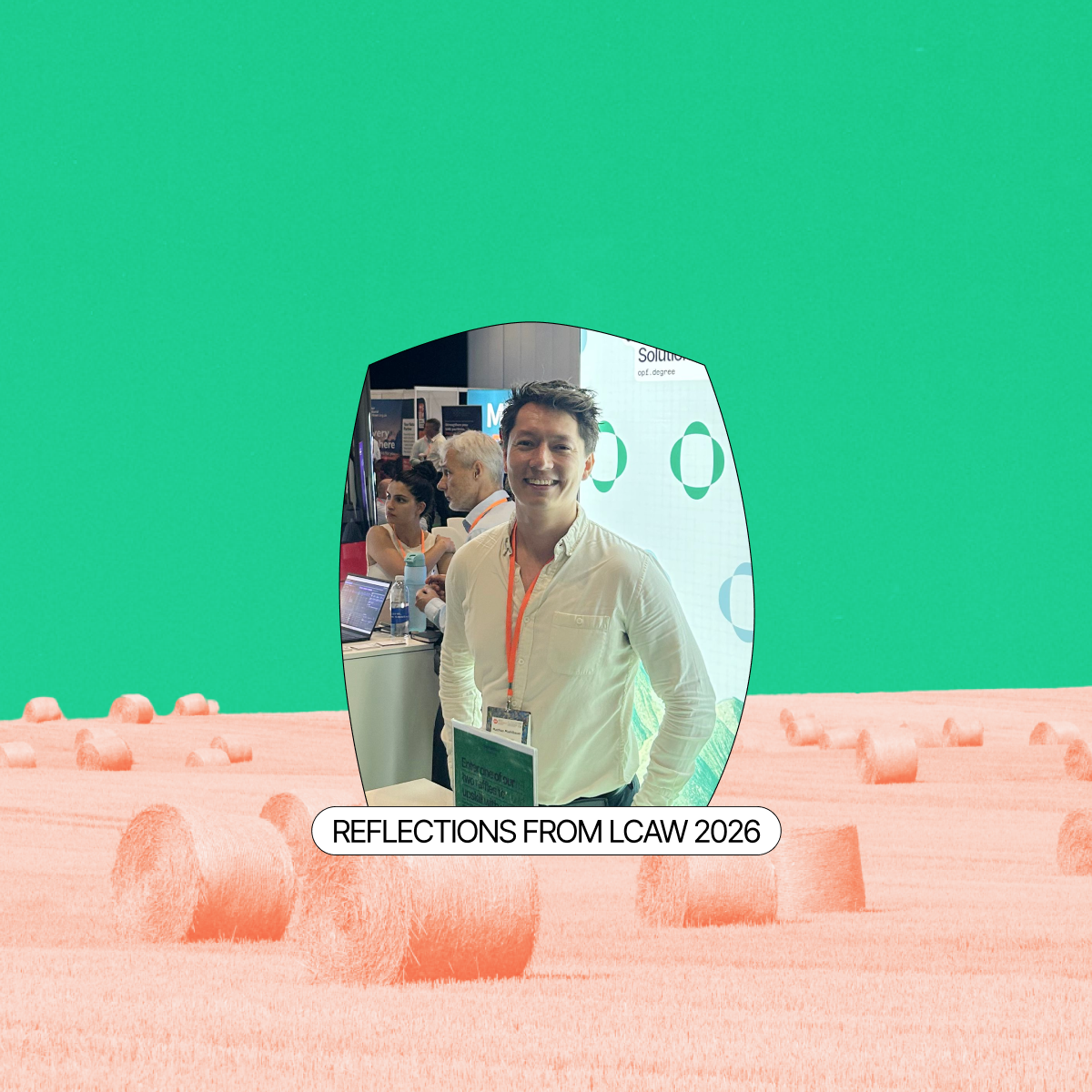
By Matthias Muehlbauer (Co-Founder & COO), OPF.
When I sat down to write these reflections, I couldn't think past the strange summer I've had. Three heatwaves so far (one in the UK, two in the US), flash floods across the Southern and Northeastern regions of the U.S, and air-quality advisories drifting down from the Canadian wildfires. Our own team has lived through most of it.
Why start a reflection on London Climate Action Week there? Because the weather forces a question: either climate weeks don't move the needle, or they push us to double down, assess what's actually working, and find the collaborators to scale it. What I found in London was the latter.
The optimism of action carried the week, despite the heat. At the Goals House opening reception, Mayor Sadiq Khan shared the headline number: LCAW convened more than 100,000 people across 1,300+ events, making it, by his account, the largest climate festival in the world, taking the crown from New York.
So what were main takeaways during this unbearably warm week? Five themes stood out to me:
1. Adaptation has entered the chat, obviously
You couldn't miss it. With commuters abandoning trains from Manchester and cooling centers opening across the capital, adaptation moved from the margins of the agenda into the middle of the conversation, at events, in the news, and in the corridors. When the venue itself is too hot to manage, how do we adapt to extreme heat transforms from a climate panel agenda item to a constant thought loop in your head. That shift in tone, from future risk to present reality, framed everything I heard during the week.
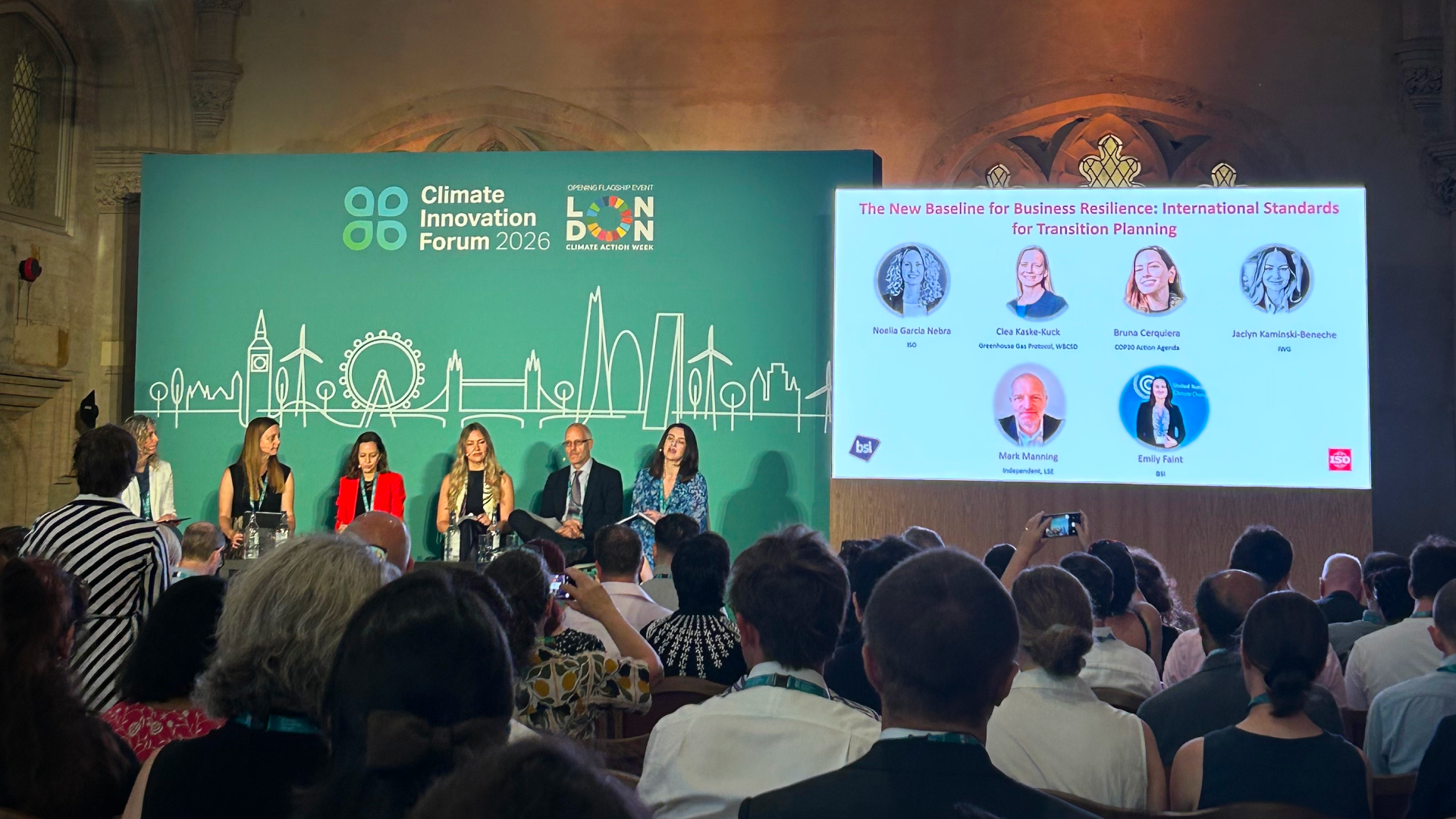
Climate Innovation Forum at London Climate Action Week 2026
2. We finally have tools to scale implementation, but…
You’ve heard this before - we ARE moving towards implementation. But to get to a consistent, agreed upon process that works everywhere, is hard. The International Organization for Standardization (ISO), an organization originally founded to reduce the friction of how business is done globally, is now, at the ready. On day one of LCAW, ISO opened public consultation on its first international standard for net zero-aligned organizations.
Standards are one of the few non-governmental mechanisms we have to scale decisions, guidance and systems across an entire market - that aren’t delayed by changes in political winds.
The catch is adoption. A standard only becomes the standard if enough of the market uses it, and standards move slowly, often three to five years, sometimes longer. As someone on the Technical Advisory Group for ISO, I see the industry effort behind the scenes; yet, policy moves at the pace of political will, and standard-setters sit outside government and are led by industry. That's their strength and their constraint. Consultants can't get every organization there alone: best-practice standards, alongside internal capability-building, are effective measures to help sustainability teams reach their transition goals.
3. The rise of blended finance, amid rising defense budgets and shrinking aid
This was the theme with the most gravity. The global trend of “turning inward” that began in early 2025, the unwinding of USAID and cuts to foreign aid in favour of military spending, has had major implications for how development gets financed. A Goals House debate between an ex-diplomat and a war correspondent, on whether the UK should raise foreign aid or defense spending amid NATO pressure and the war in Ukraine, was one of the most interesting sessions I attended.
The consequence for development finance is a shift in how governments position: from donor to investor. Governments are now looking to crowd in private capital alongside their own, and as they do so, are searching for untapped capital pools. At a Chemonics, Convergence and Triple Effect Capital event on blending development finance with insurance and pension allocations, one line stuck with me: "We have enough financing to cover our climate goals. It just isn't being deployed." (A close cousin of the stat that only ~2% of philanthropy goes to climate.)
The institutional capital is enormous. So why isn't more of it flowing? Part of it is perceived risk in developing markets, though as proven renewable technologies scale, from Pakistan to Nigeria, that technology risk (and the overall risk) keeps falling. Part of it is structural: Solvency II capital requirements still constrain how much insurers can allocate to blended-finance vehicles.
The takeaway from the panel was direct, commercial, and obvious. Blended finance has to present a compelling institutional investment proposition, with competitive returns and transparent risk allocation, not just an impact story. The Allianz Credit Emerging Markets (ACE) fund is the model, using public first-loss capital and guarantees to strengthen its appeal, and attracting a Swiss pension fund at first close. It mirrors what we've seen in our own Sarona ADI blended-finance work. Encouragingly, policy may have downstream effects here. The Prudential Regulation Authority's Supervisory Statement 5/25 tightens expectations on how UK banks and insurers govern climate risk, part of a broader update of fiduciary duty as long-term financial resilience rather than a sustainability nice-to-have.
When I think back to my Economics 101 undergraduate days, I think back to savings rates and how large savings funds can mobilize development, and action (think Singapore, and China). These large pension and insurance funds include the funds of everyday people - could we have these funds fill that gap in financing development at this point in time where we’ve seen retreating foreign aid?
4. The green skills gap persists, and now it's twinned with AI
LinkedIn released its latest UK Green Skills Report during the week, and the numbers back the transition, and the drum OnePointFive has been beating for a while: green talent in the UK is hired 38.1% faster than the overall workforce, yet demand is outpacing supply 1.8x, green hiring grew 7.8% a year from 2021–2025 while green skills grew only 4.2%. Green skills, as the report highlights, are "economic infrastructure… essential to competitiveness, productivity and resilience, not just net zero delivery."
The second thread is the one reshaping our own advisory work: AI and green skills are converging fast. Green talent adding AI engineering and AI literacy skills grew 28.4% and 53.2% year-on-year in 2025. More of our client conversations now open with "how do we measure our AI usage and adopt a responsible AI approach?" rather than "how do we decarbonize?" The opportunity, as the report frames it, is to treat the twin transitions as one strategic capability, not two parallel problems. That's the thesis behind our enterprise training work.
5. Industrial decarbonization is still hard, and AI makes it harder
I co-hosted a salon to kick off the new Catalyze conference scheduled for next year in April, a new conference on the climate calendar focused on industrial decarbonization, driven by the American Society of Mechanical Engineers and Constructive (a firm behind the Department of Energy’s now cancelled, but successful energy conference, DEPLOY). With industrial sector leaders at the table, the group landed on some groundtruth: for the next five years, the biggest constraint on industrial decarbonization isn't process technology - it's access to cheap, clean power and the grid to move it. Transmission bottlenecks and interconnection queues keep renewables from reaching industrial users even when the generation exists
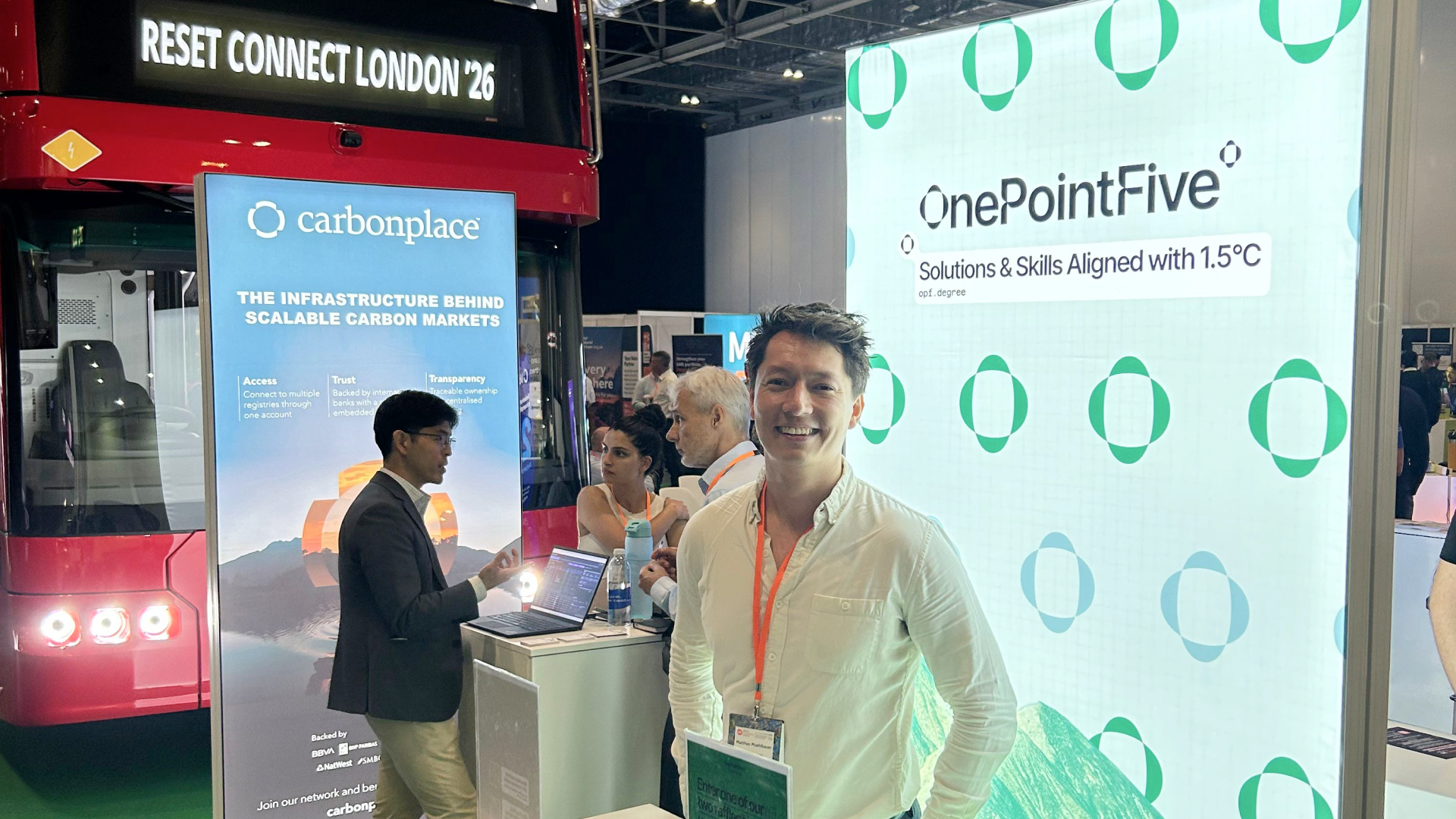
Matthias Muehlbauer (OnePointFive) at Reset Connect, London Climate Action Week 2026
And industry now has a bigger competitor for that power: compute. Hyperscalers can outbid industrial users, with higher margins, deeper backing, and greater willingness to pay. This is what I heard whispers of at last year’s New York Climate Week from upstream industrial suppliers.
Meta's 7 GW of new gas in Louisiana, on a 14 GW grid, is the cautionary tale, with the company covering only a few years of a 30-year asset and ratepayers left holding the rest. The irony is that the fastest route to new power today is wind, solar, and batteries, with existing interconnection; gas turbines take three to five years, transmission upgrades up to ten. AI dominates the headlines and the queue, and industrial electrification, with far fewer resources to compete, gets crowded out. With EU ETS free allowances ramping to zero by the end of the 2030s, heavy industry can't afford to be last in line.
What this means beyond London
If a heatwave can disrupt the world's largest climate gathering, it can disrupt supply chains, cities and infrastructure just the same. That's the case for building resilience alongside decarbonization, not after it, and we’re seeing this in some of our latest work for a billion-dollar CPG company where we’ve analyzed climate risk across extreme climate events, and are executing on business continuity and resilience planning to prepare for increasing wildfire risk in Southeast US.
New York Climate Week is just weeks away. Governor Hochul's data center moratorium echoes the success of London's Ultra Low Emission Zone: sub-national leadership delivering measurable emissions, health, and community outcomes. Add in the latest H1 figures showing climate-tech investment at its highest since H2'25 — driven largely by low-carbon data centers like DayOne and NScale — and I'm cautiously optimistic we're about to turn a corner.
Are we out of the climate down-cycle? Time will tell. But at the same time, we don't have time.
See you in second-placed New York in September.
Want to stay in the loop?
Subscribe to our newsletter for more fresh insights, practical tools, and real-world examples to help you stay ahead of the rapidly evolving climate and sustainability landscape.