by Elaine Liu (OPF 2026 Summer Strategy Consultant)
The next global competition over AI will not be won by countries who build the best models, but by those who have the capacity to host them.
As frontier AI (i.e., the most advanced, large-scale AI models available) continues to push the limits of electricity, transmission capacity, and digital infrastructure, geography is becoming as important as technology, if not more. Building AI-supportive data centers is no longer just an infrastructure challenge. It is an economic, geopolitical, and environmental one. Decisions about where AI infrastructure is built will shape where it can scale, who can capture the value it creates, and who ultimately bears the costs of supporting it.
What makes frontier AI so different from other digital technologies? The intensity and rate of physical infrastructure growth required. Every new generation of model relies on increasing amounts of electricity, land, water, specialized hardware, and access to transmission capacity. As a result, countries seeking to compete in AI on a global scale will require sufficient infrastructure to support increasing computational demands over the long-term.
One answer comes from the International Data Center Authority’s (IDCA) Global Energy Report (2026). In response to the electricity constraint on AI development, the report introduces "Goldilocks Nations": countries that have the right balance of energy availability, grid capacity, and policy stability to support AI deployment. This is an important shift in the AI competition conversation; rather than focusing on frontier models, it argues that the next phase will be shaped by long-term infrastructure and energy planning.
As such, countries with abundant clean energy, grid capacity, and supportive regulation are well positioned to attract AI investment. But that’s only the first step. The real question is what countries gain from hosting, and whether their investment in AI will translate into lasting economic, technological, and social benefits. Infrastructure readiness alone does not guarantee these outcomes; hosting data centers does not automatically translate into stronger local industries, technological leadership, or even long-term economic development.
That distinction is central to sustainable AI. In this context, sustainable AI means developing and deploying AI in ways that are environmentally responsible whilst also supporting resilient economies and communities over the long term. This means looking beyond the efficiency of models to consider how the infrastructure required to power AI affects its surroundings. Countries and communities providing the land, energy, water, and other resources needed for AI should also have opportunities to benefit from the economic activity and capabilities it creates. As governments compete to attract AI investment, sustainable AI therefore needs to encompass local value creation, environmental stewardship, and climate justice alongside operational efficiency.
AI infrastructure as strategic national infrastructure
The focus on infrastructure is tied closely to another shift taking place: the rise of “sovereign AI”. Increasingly, governments are recognizing that AI capability goes beyond developing powerful models. It also includes where those models are trained, where they are hosted, who owns the underlying infrastructure, and who controls the data flow. Compute capacity is becoming a strategic resource, much like energy, telecommunications, or transportation networks.
This is driving waves of investments in domestic infrastructure building. The European Union’s Data Union Strategy seeks to strengthen Europe’s digital sovereignty by improving access to trusted data and expanding domestic digital infrastructure. Likewise, South Korea has increased investments in public AI computing infrastructure to stimulate development of a national foundational model, reflecting a broader effort to ensure that future AI capabilities are not entirely dependent on foreign providers.
Against this backdrop, data centers are no longer seen as passive facilities that store information. Instead, they have become the physical infrastructure that supports scientific research, national healthcare, and defense.
Though data centers enable the AI economy, much of AI’s highest economic returns occur elsewhere; the money is in semiconductor design, foundation model development, software platforms, and intellectual property. For governments, this creates a dilemma. Building data centers can generate investment, construction activity, and operational jobs, but long-term economic benefits depend on whether infrastructure allows the ‘human intelligence and value’ layer, like local research institutions, skilled workers, and businesses, to participate in the AI value chain. Without this connection, countries may end up providing the physical foundations for AI and leaving most of the economic returns elsewhere.
This perspective also expands the definition of AI readiness beyond compute capacity to whether that capacity can support lasting technological capability, resilient industries, and shared prosperity.
Infrastructure readiness is necessary, but not sufficient
Governments that have committed to expanding domestic AI capacity face another set of questions: where should the new facilities be built? How should they be powered? And how can the benefits of AI infrastructure be shared fairly with the communities that host it?
The same characteristics that make a location attractive for data centers, such as abundant electricity, available land, and lenient policies, can also create risks if projects are developed without considering local conditions. Electricity, water, and land are all finite resources. Decisions about how they are used will inevitably involve trade-offs, particularly in places already experiencing water stress or climate-related risks.
The proliferation of AI data centers in the United States highlights this challenge.
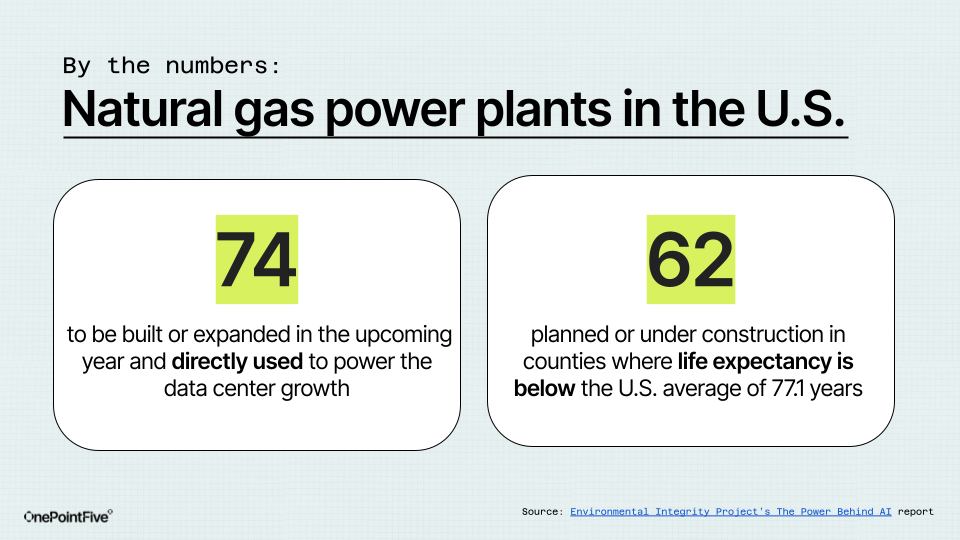
As demand for compute has accelerated, developers have increasingly looked for ways to secure dedicated sources of electricity. The Environmental Integrity Project’s The Power Behind AI report identifies at least 74 natural gas-fired power plants to be built or expanded in the upcoming year that will be directly used to power the data center growth across the U.S. To avoid the grid permitting bottlenecks, these will be built “behind-the-meter”, expediting the time to the first electrons generated. Altogether, these facilities could add up to 143GW of capacity, generating substantial emissions and air pollutants that will affect local communities without the benefits of adding more electricity to the grid for community use.
Source: Environmental Integrity Project’s The Power Behind AI report
Of the proposed plants identified in the EIP report, 62 are planned or under construction in counties where life expectancy is below the U.S. average of 77.1 years. In fact, most of the communities already face socioeconomic challenges and cumulative environmental burdens. And now these communities are being asked to accommodate additional water stress, noise and air pollution, and pressures on local infrastructure to support an AI economy whose largest rewards have been realized elsewhere.
AI infrastructure expansion is perhaps inevitable, but it is important for the industry to realise that where and how infrastructure is developed matters just as much as how quickly it can be built. And these questions become even more important as AI infrastructure expands beyond today’s established hubs.
Expanding the framework through a climate justice lens
According to the European Union, the world's six largest emitters - China, the United States, India, the EU27, Russia, and Indonesia - accounted for approximately 61.8% of global greenhouse gas emissions in 2024. In comparison, many countries expected to attract future AI infrastructure, such as the “Goldilocks Nations” mentioned in the IDCA report, have low historical emissions, whilst remaining among the most vulnerable to climate impacts, including water scarcity, food insecurity, and extreme weather.
As developers search globally for the best place to build AI infrastructure, there is a distinct possibility that AI's environmental footprint will become concentrated in regions that have contributed relatively little to the climate crisis, even as much of AI’s economic value accrues elsewhere.
Many governments currently see this digital infrastructure as an opportunity to accelerate economic development, attract investment, and secure energy autonomy amidst the global energy crisis. Those ambitions are understandable and important for national security. The challenge, however, is in ensuring that AI infrastructure becomes a step towards domestic growth rather than an export industry.
For countries working still to expand overall electrification and access to healthcare and essential public services, dedicating any amount of generation capacity to computing requires trade-offs. It would be reasonable for governments to decide that supporting domestic industries and communities should take priority over exporting computational capacity. And unless countries are certain they will be able participate in the higher-value activities of AI development, they risk carrying the burden of AI's environmental footprint whilst capturing only a fraction of its long-term benefits.
Environmental justice scholars often use the term "sacrifice zones" to describe communities that bear “high levels of pollution and environmental hazards” due to toxic or polluting facilities nearby. As governments and companies decide where AI infrastructure will be built in the upcoming years, avoiding the creation of new sacrifice zones should become an explicit objective.
Energy availability and permitting speed matter, but they should not be the only requirement guiding investment decisions.
From infrastructure deployment to shared value creation
Recognizing the broader sustainability impacts does not require us to abandon the Goldilocks framework. The IDCA has made an important contribution by spelling out the infrastructure conditions required to support AI growth. But infrastructure readiness only answers one question: where can AI be built?
A broader systems perspective requires extending the question to: where should AI be built, and under what conditions will that investment create lasting value for the communities that make it possible?
For governments and investors, this means looking beyond technical feasibility. Siting decisions should consider not only whether a location can support additional computing capacity, but whether the planned facility will bolster long-term economic growth, environmental sustainability, and social wellbeing.
This definition of AI readiness requires us to look beyond megawatts and data center capacity to the broader web that determines whether AI investments will deliver shared returns.
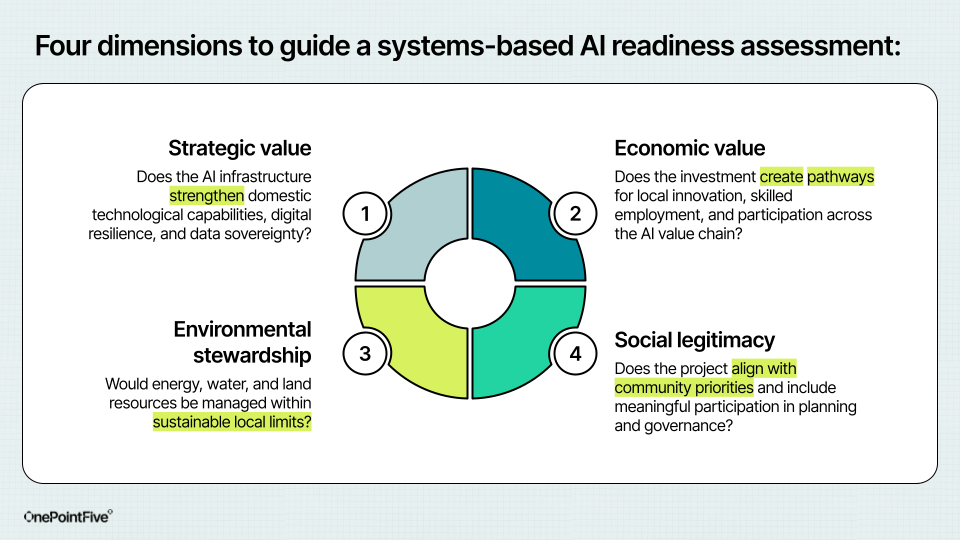
The four dimensions to guide a systems-based AI readiness assessment: strategic value, economic value, environmental stewardship, and social legitimacy.
Together, these dimensions shift the conversation from infrastructure building to actual value creation. With this perspective, the most attractive locations may not necessarily be those offering the lowest costs or the fastest permitting timelines. Ultimately, the countries that are best suited to be resilient homes for AI development will be the ones that combine reliable infrastructure with skilled workforces, clean energy, and public trust.
A broader vision for sustainable AI
Every major wave of infrastructure buildout has reshaped our global economy: ports transformed international trade. Railways defined the cities of industrialization. Electricity created modern manufacturing.
AI infrastructure will be no different.
The choices being made today about where computing capacity is built will end up shaping the patterns of innovation, investments, and geopolitical influence for decades to come. They will also determine how the environmental costs and economic rewards of AI are distributed across countries and communities.
To date, much of the conversation around sustainable AI has focussed on carbon emissions, renewable electricity, and water use. But sustainability does not stop at operational performance.
As AI becomes foundational infrastructure for the global economy, the conversation must also consider ownership, governance, value creation, and fairness. It must ask who benefits from AI infrastructure, who bears its environmental footprint, and whether the communities providing the public resources needed to power AI are able to participate in the prosperity it generates.
The future of sustainable AI depends on building an ecosystem where AI development strengthens local economies and supports surrounding communities.
Go beyond the theory
The questions around AI infrastructure, governance, and shared value are becoming increasingly relevant for organizations deciding how and where to use AI. Our freshly launched Sustainability and AI Accelerator brings these conversations into practice, helping practitioners develop an AI policy, emissions plan, or framework for buying and building AI more sustainably.
The Accelerator starts October 19, 2026. Learn more and apply: